Saturday, March 2, 2013

Angkor Wat

You can read all the superlatives you want about Angkor Wat, but not really comprehend the scope, complexity, and ornateness of the temples until that first vast moat is crossed, the first stone bridge traversed, and the first stupas come into sharp focus beneath a bright blue sky.  Hundreds of temples survive today and selecting an itinerary is difficult. 

We began with Angkor Thom--and an elephant ride.  Touristy, yes, but it forces you to accept the elephant's lumbering pace and enjoy the view from an unusually elevated perspective.  It is impossible not to imagine what it must have been like when Angkor--with a population of one million when a mere 50,000 souls lived in London--teemed with people and elephants were a common mode of transport.  Only the temples, made of sandstone quarried more than twenty miles away and floated downriver on rafts, survive today.  All houses have long since vanished as they were made of wood--sandstone was only for the gods. 


                                                  They found an elephant big enough...

Terrace of the Leper Kings

                                                              Terrace of the Elephants


Angkor Thom includes the immense Terrace of the Elephants, used as a viewing stand for public ceremonies, which features sculpted elephants flanking every staircase.  The nearby Terrace of the Leper Kings, supposedly named for two Angkor kings who were afflicted with the disease, is richly decorated with tiers of elaborate carvings.  The Bayon, the center of Angkor Thom, features bas-reliefs displaying more than 11,000 figures depicting all aspects of everyday life in Cambodia during the 12th-century.  After climbing a narrow set of stairs, more than 200 staring stone faces great every visitor. 

Angkor Thom


Bayon Temple


Angkor Wat is reached after crossing a moat far wider than any I've seen in Europe or Japan.  The temple complex itself is the largest religious building in the world and the bas-relief along the outer walls is the longest continuous bas-relief anywhere.  The best preserved temple in Angkor, Angkor Wat is beautiful on many levels--its immense size, brilliant architecture, and the delicate artistry of the carvings that line seemingly every surface. 


                                                      A branch of the immense moat

Angkor Wat


A section of the bas-relief


It is interesting to note that much of Angkor had been reclaimed by the jungle until the French decided to excavate the temple ruins.  A visit to Ta Prohm underscores the fact that nature can reclaim anything built by humans.  Ta Prohm seems ripped from a movie set and, indeed, scenes from Laura Croft Tomb Raider were filmed there.  There is a feral beauty in the way the tree roots have locked the crumbling stones in a tight embrace. 


                                                      A face obscured in the tree trunk


We stayed in Siem Reap at the Raffles Grand Hotel D'Angkor, again enjoying superb service and accommodations.  This Raffles location acquired the property from another hotelier and updated it, although it preserved many original features including a mahogany elevator from the 1920's.


We enjoyed an evening on Pub Street, named--well, you can figure that out.  Dinner was at a fine restaurant called Wat Damnak, which specializes in fresh and locally sourced ingredients.  They offer two tasting menus each evening in very cool space that is off the beaten path and well worth the brief remork ride.  I dined on fried Sanday fish with a pomelo and elephant ear taro stem salad, black sticky rice with crispy duck, Mekong langoustine with seared tiger eggplant and, for dessert, wild Cambodian cinnamon and chocolate light ganache.  This was my favorite meal in Cambodia except, of course, for the tarantulas. 


Cambodia: The Horror of the Khmer Rouge

One of the more gripping visits of the trip was a visit to Tuoi Sieng Museum, a high school that the Khmer Rouge converted into a "security prison"--in reality, a brutal torture chamber.  The stark rooms where people were taken to be interrogated and brutalized, before being executed at the notorious Killing Fields 14 miles outside of the Phnom Penh, are haunting.  The cramped brick chambers where prisoners were held while waiting to be tortured are appalling, but it was really disturbing to learn that the Khmer Rouge had figured out various ways to use the playground equipment as instruments of torture. 


                                                               Interrogation Room


House Rules--click to enlarge
 
                                                            One of the school buildings

Each room filled with several small cells
 
                                                      Restraint cemented into a cell floor
 
 
It is believed that two million people, or one-third of Cambodia's entire population at the time, was wiped out by the Khmer Rouge.  Specifically targeted were all professionals and educated people, and the loss of people with skills and education has undoubtedly hampered to this day Cambodia's capacity to develop.  On an optimistic note, the country seems committed to developing a strong educational system.  

Meticulous record keepers, the victims of the Khmer Rouge are well known and there are rooms of photographs at Tuoi Sieng.  I had never seen eyes convey such an utter sense of hopelessness. 


On a positive note, the hotel sponsored a Lion Dance the afternoon following my morning visit to Tuoi Seng and the sheer exuberance of the performers was uplifting. 


Cambodia: Haunted Past, Promising Future

A short flight from Bangkok brought us to Phnom Penh, Cambodia and our new guide, Sky.  It is immediately noticeable that impoverished Cambodia lacks the glitter of relatively affluent Thailand.  Traffic alone tells the tale.  Whereas nearly everyone in Thailand seems to have an auto (with the assistance of government subsidies), cars are nowhere near as common in Cambodia and nearly everyone, it seems, navigates the city on motorcycles or, to a lesser extent, bicycles.  Tuk-tuks, called remorks in Cambodia, are omnipresent.  And Phnom Penh traffic makes Bangkok traffic look tame. 

Motorcycles weave through any open space and swerve mere inches away from other traffic.  Remorks do the same thing.  So do cars.  And pedestrians. I have never witnessed roads more chaotic in my life.  At the few traffic lights, motorcycles jockey to the front and take off in a group as soon as someone senses that the light is about to change.  At most intersections, there is no light so people just go and assume that someone else will stop.  Left turns are an adventure. Complicating matters is the apparently common practice of driving on the wrong side of the street.   Accordingly, it was not unusual for oncoming traffic to be on both sides of our vehicle. 

When we finally reached the Raffles Hotel Le Royal, we were ready for a drink and nestled into the Elephant Bar.  The room seemed to have been preserved from the days of the French occupation and retained a whiff of the colonial era.  The entire property had an air of faded glory--everything was clean and well-maintained, but nothing appears to have been remodeled.  The uniformed staff were indefatigably polite and waited on everyone hand and foot.  It seemed as though we had stepped back in time and the hotel was one of the most enjoyable that I've ever visited.   

Elephant Bar
  

We toured Phnom Penh and it is evident that the country is still recovering from the havoc wreaked by the Khmer Rouge in the 1970's--and more on that in the next post.  Sky was a child of six when the Khmer Rouge took over.  Separated from his family, he worked at a camp making fertilizer from human and animal waste, plant material, and crumbled termite mounds.  He explained that the teenage guards pretty much left them to fend for themselves and that the kids typically slept outside under trees.  The following dialogue was eye-opening:

Me: "You must have been terrified sleeping in the forest, with all of the snakes and insects."

Sky: "Are you kidding me?  We prayed for snakes and insects because that meant we had food."

Even today, Phnom Penh has fewer residents than it did before the Khmer Rouge evacuated the city in pursuit of creating a self-sufficient agrarian economy.  Seventy-five percent of the people of Sky's age are illiterate.  Average income is $2.00 a day.  Poverty is reflected in the housing and clothing of the people and the general lack of maintenance of public areas.  Cobwebs clung to statutes in the National Museum.  As Sky said, however, people at least smile now and believe that the country has a future. 

Much of the Royal Palace was shuttered during our visit due to the recent death of the King.  We also toured the Central Market, although several stalls were closed due to the Chinese New Year and the substantial Chinese population in Phnom Penh.  A highlight, however, was visiting Wat Penh and witnessing a Lion Dance in celebration of the New Year.

Royal Palace


Central Market


Wat Penh


                                                              The Lion Dance begins


A recommended spot for dinner is Komdeng Restaurant, which features Cambodian cuisine and cocktails prepared with local fruits.  I had deep-fried tarantulas for an appetizer--a little crunchy in spots due to the carapace, but with a mild flesh.  That was followed by squid stuffed with pork, shrimp, and black mushrooms with a koh kong sauce.  Good service and nice atmosphere, although I am still trying to convince myself that the small, black creature which scurried across the floor during dinner was a cat. 

A tasty tarantula


Ancient Kingdoms, the Flower Market, and the Business of Sex

The second day of our trip brought us to Ayuthya, the capital of Siam for over 400 years, located approximately 50 miles from Bangkok.  The ruins of the ancient city sprawl forever and make for some fascinating exploration.  Wat Phra Mahathat has a captivating sight: a Buddha head engulfed by tree roots.  Wat Prha Si Sanphet is a warren of stupas.  It was the palace for several kings and each king was expected to erect a stupa for his parents and other family members, so the proliferation of stupas at Wat Prha is likely unmatched. 


We next toured the sprawling Summer Palace of King Rama V at Bang-Pa-In.  The complex features a variety of architecture, including European, Chinese, and Thai.  Through a combination of ceding territory and playing various European interests against each other, Thailand was one of the few Indochinese countries that was never colonized.  For example, when the King was concerned that the English and French were becoming too aggressive, he invited the Russian Czar to visit the Summer Palace and forged a relationship with Russia. 


We returned to Bangkok by riverboat, with a forgettable buffet lunch but memorable cold beers, and enjoyed the ever-changing view of the riverbank.  Dilapidated fishing shacks contrasted with the glitz of Bangkok, and the river teemed with boats of every variety, from barges to tiny canoe-like vessels.  Boats with huge rear engines and extended propellers stood out as they zipped along.  They have been called "James Bond" boats after such vessels appeared in "The Man with the Golden Gun." 


                                                            A 'James Bond' Boat


After a rest at the hotel, we met our guide for an evening tour of the city.  Our first stop was the Flower Market, which stretched for blocks and teemed with people.  The flowers--including more orchids than I've ever seen--were dirt cheap and the scene was chaotic.  The narrow lane between flower stands was difficult to navigate and the food vendors and the clacking tuk-tuks and the roaring autos and the bustle of human beings seemed to blend into a kind of choreographed chaos.  The colorful, raucous scene was fascinating. 


The illuminated temples were beautiful as well.  We had dinner at Supatra River House, a fine restaurant on the riverbank, and enjoyed the spectacular view of Bangkok at night.  Standout items included Tom Yum Kung, a slightly spicy coconut based soup with prawns, and a terrific soft shelled crab with steamed rice.  We really enjoyed Thai food, and the breakfasts were particularly interesting because of the variety of fresh fruit.  Standouts included mangosteen, longan, dragon fruit, and rambutan.  I'd sampled some of these before, but others--like longan (shielded by as thick skin, the grape-like fruit inside reminded me of lychee)--were unfamiliar. 


We had our first tuk-tuk ride and it was a blast.  Nothing felt so foreign to me as racing along the streets of Bangkok in what essentially amounts to an open-air carriage affixed to the rear of a motorcyle.  And the drivers are fearless, jockeying around and between trucks and autos as if they weren't there and rocketing inches past pedestrians who seem accustomed to near-death collisions.


After dinner, we strolled the storied Khao Sarn Road and found the jarring cacophony interesting.  Hustlers of every race, creed, and color offered massages or prostitutes.  Street food vendors hawked scorpions on a stick and a variety of other bugs--photos were one dollar.  Several entrepreneurs openly offered fake ID's and nightclubs blasted American music.  Women of the evening flashed hard stares and smiles from sidewalk patios.  Pedestrian traffic, a melange of backpackers, middle-aged tourists, and locals hustling for a buck, was shoulder-to-shoulder.  What Khao Sarn Road lacks in glamour in makes up for in sheer chaos. 

We paid a brief visit to Patpong, one of Bangkok's infamous 'entertainment' districts, afterwards.  Actually, we made it as far as the adjacent Patong night market before I wearied of the constant propositioning and jostling.  Prostitution is an accepted way of life in Bangkok, as are the 'ladyboys'--men who impersonate women--and it is understood that a significant part of the tourism industry consists of 'sextourists' who visit Thailand for reasons that have little to do with temples.  Curiously, prostitution is totally illegal but thrives, apparently due to the ageless combination of money and corruption.  A sharp contrast, indeed, to the beauty of illuminated temples and the gentle flow of the Chao Phraya river. 

Bangkok: Of Golden and Emerald Buddhas, the Monkey King, and a Bar in the Sky

Bangkok pulsates.  From the moment you arrive at the mammoth Suvarnabhumi International Airport, this is a city of non-stop riotous commotion.  We checked into the Mandarin Oriental, on the bank of the serpentine Chao Phraya river, and caught some sleep after over thirty long hours in airports and planes.  Despite being exhausted after the long flights, the stunning view from the window of the Mandarin kept me awake for some time--a swirl of lights spiraling from the ground to the tops of lofty skyscrapers and lighted boats plying the dark waters of the river.  Bangkok. 

The first day was overwhelming.   Our guide, Tony, led us first to Wat Traimit, the Temple of the Golden Buddha.   The Temple itself is not particularly impressive, constructed fairly recently specifically to house the Buddha, but the Golden Buddha itself is jaw-dropping--5.5 tons of solid gold.  Interestingly, to protect the Buddha from invading Burmese, it was covered with plaster ages ago.  While being moved to a new shelter in the mid-1950's, the Buddha was dropped from a crane and a monk inspecting the cracked plaster discovered the true nature of the Buddha.

                                                              The Golden Buddha


The Reclining Buddha
 
 
Perhaps even more striking was our visit to Wat Pho, housing the famous reclining Buddha--all 148 feet of it crammed into a long and narrow temple.  The Buddha's mammoth feet are crafted from mother of pearl.  Wat Pho is a fascinating complex, home to Thailand's first university and the birthplace of Thai massage. 

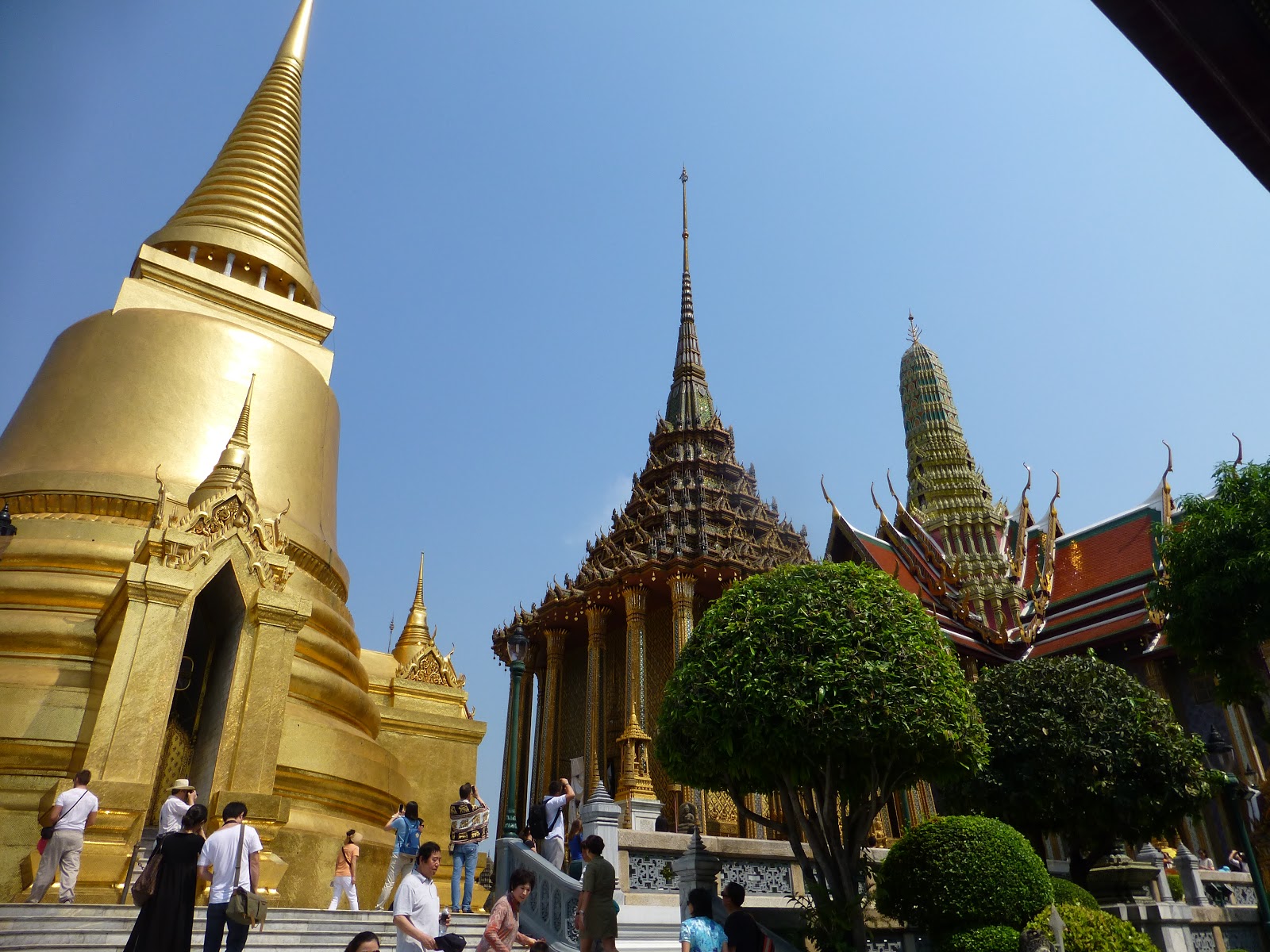
While our morning tour was amazing, the afternoon visit to the Grand Palace exceeded all expectations.  The complex is a maze of soaring stupas and striking temples, pitched so closely together that taking everything in is overwhelming.  Despite the stifling heat--98 degrees and humid as a bucket of tepid water--we strolled the grounds like kids at a candy store, eagerly awaiting the next architectural wonder.  One of the highlights is certainly the Emerald Buddha, carved from a single piece of nephrite, a type of jade.  Wars with Burma were fought over this Buddha, with the Thai people eventually capturing it and enshrining the Buddha within the Grand Palace complex.
Also impressive are the 178 Ramakian murals, wrapping around a 2km cloister, and depicting the epic clash of humans uniting with the monkey king to conquer an evil alliance of enemy humans and demons, all to reunite a pair of young lovers. 

                                                            The Emerald Buddha


Ramakian Mural Panel


A few particularly colorful temples are crafted from English pottery that was broken in the holds of ships crossing the ocean.  The striking Phra Si Rattana Chedi is covered with golden tile imported from Italy.  The throne hall, Chakri Maha Prasat, is a fusion of Thai and European architectural styles.  Despite the oppressive heat and humidity, I left the Grand Palace reluctantly because it truly is a complex where another surprise lurks beyond every corner. 

Exterior of Broken Pottery


We capped our evening with a visit to the open-air Sky Bar and Sirocco restaurant, perched atop the 63rd floor of the State Tower Building.  When you walk outside, a winding, vertigo-inducing, staircase leads to the oval shaped bar which is cantilevered over the cityscape far below.  Not a view for the faint of heart, but a few stiff drinks seem to help one cope with the sheer drop to the ant-like figures scurrying about the hectic streets 63 stories down.  We enjoyed dinner while a jazz quartet played from an elevated platform and then concluded our evening with a cigar and cocktail back at the Mandarin.  All in all, not a bad first day in the boisterous and fascinating city of Bangkok.