Sunday, November 10, 2013

Jewels Near Lisbon: Queluz,Sintra, Cascais, and Estoril

Construction of the pink rococo Palacio Nacional de Queluz, referred to by some as the Portuguese Versailles, was commenced in 1747 as the summer residence of King Pedro III.  During the French invasions of the 18th century, the Royal Court was transferred to Brazil and most of the Palace's furnishings were shipped to South America.  Accordingly, much of the Palace today is sparsely furnished.  However, the Royal quarters are splendid, particularly the Don Quixote Chamber, where Don Pedro was born and, following his return from Brazil, passed away.  Beautiful tile work is evident and the wooden parquet flooring and ornate, inlaid furniture pieces are stunning.  Many foreign dignitaries have stayed at the Palace when visiting Portugal. The expansive gardens, complete with a canal bordered by colorful tile work, are definitely worth a stroll.


Lord Byron referred to Sintra as a "glorious Eden" in 1809.  Today, although mobbed by tourists, its charm remains.  A picturesque mountain village, the views from Sintra are beautiful, encompassing lush valleys and luxurious villas that sprawl toward the Atlantic coast.  The panoramic vista from the balcony of the Palacio Nacional de Sintra is striking.


Town of Sintra

Palacio  Nacional de Sintra

Village street


Seemingly balanced on the mountain peak that looms above the village is the Palacio Nacional de Pena.  This fantastical structure's last royal occupant was Queen Amelia, who fled in 1910 when it was clear that the Portuguese monarchy was collapsing.  We were unable to visit the Palace due to Linda's loathing of heights.  However, we understand that the Palace retains the personal effects of the Queen and therefore provides a rare glimpse of royal life in the days preceding WWI, similar to the Hapsburgs' Konopiste Castle near Prague (see post of April 12, 2011).


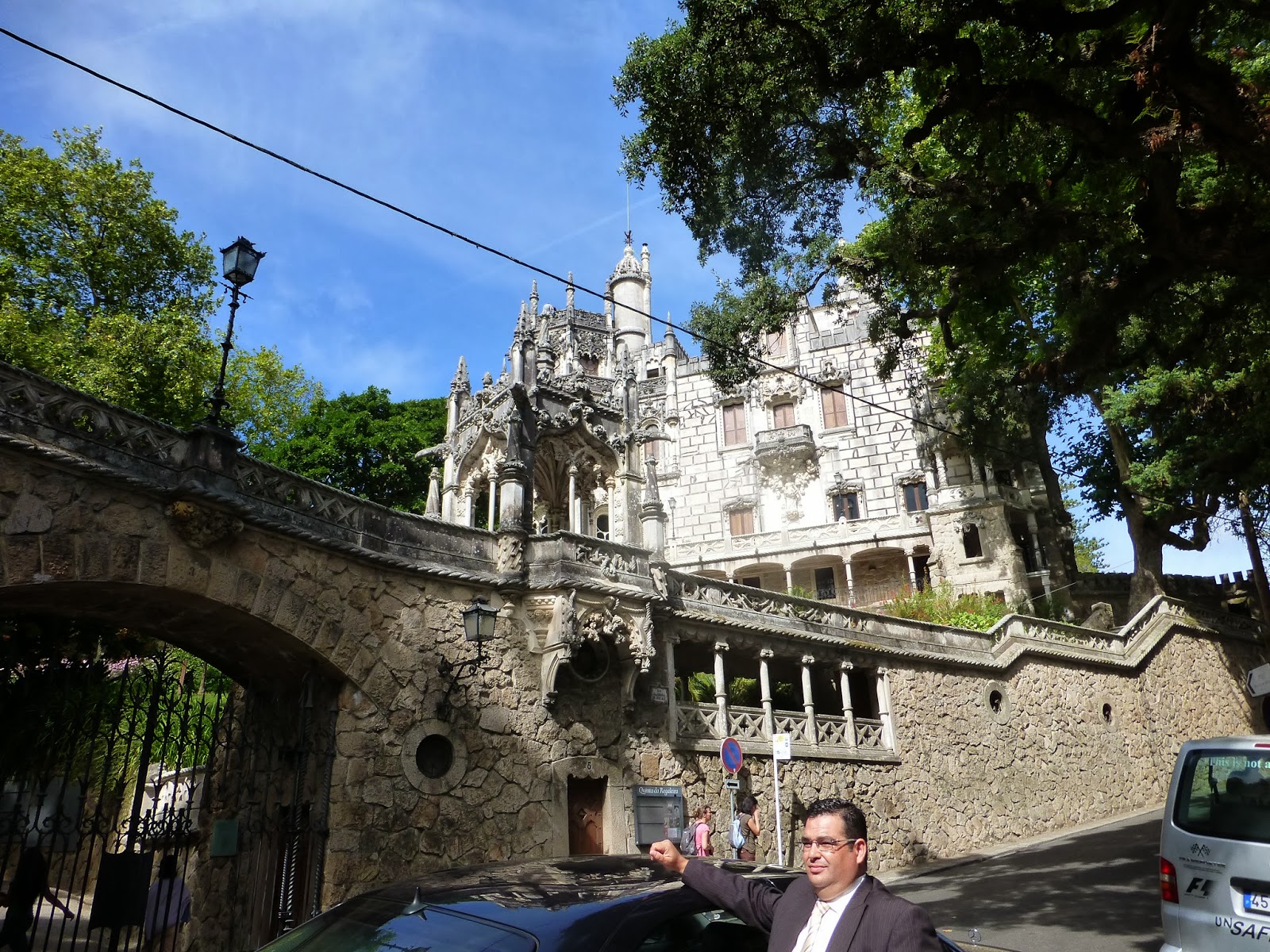
Numerous palaces dot the verdant landscape and we visited Quinta da Regaleira, summer home of Carvalho Monteiro.  Monteiro, an attorney, inherited vast wealth from his parents, who had made their fortune in the Brazilian coffee industry.  Monteiro eventually lost his fortune, but not until he completed his imaginative palace in 1912.  The elaborate structure passed through several hands until it was acquired by the municipality of Sintra in 1997, restored, and opened to the public.  The design is what I will label an exuberant manueline style, with an abundance of spires, turrets, and gargoyles. Some of the interior ceilings are chestnut, intricately carved and fanciful.


Just as striking are the mystical gardens, intended by Monteiro to reflect our quest for a superior Being, and there are numerous references to mythological characters, authors such as Dante and Virgil, and the Templars.  The gardens are immense, containing stands of chestnut and sequoia, elaborate fountains, and meandering grottos.  An "initiate well" supposedly relates to the Templars and is accessible via an ornate, spiral staircase that descends 27 meters.  At the base, a tunnel connects the well with the palace itself. 

From Sintra, we traveled to the coastal village of Estoril and sweeping views of the broad, white sand beaches.  The area is gorgeous and it is easy to understand why, as the Nazis marched across Europe, many royal families fled to Estoril to ride out the war in neutral Portugal.  We lunched at a small restaurant overlooking the ocean and enjoyed fresh oysters, grilled lobster, seafood with rice, and stuffed spider crab.  The seafood dish was nothing like paella and consisted of an array of seafood mixed with white rice and a rich, red sauce.  Our meal was accompanied by a light and fruity vinho verde, or green wine, made from grapes that are picked when young.

World famous surfing beach

Local crab salad

Local lobster

Typical seafood stew


We ended our tour in Cascais, a town dominated by an imposing 17th-century fort on the waterfront.  The small harbor sparkles with the brightly painted hulls of numerous fishing boats, testament to the fact that Cascais has not lost its fishing heritage.


Saturday, November 9, 2013

Evora, World Heritage Site and a Chapel of Bones

Our exceptional driver/guide, Sergio (Sergio.signtours@iol.pt) drove us from Lisbon to the small, provincial capital of Evora, unique for its range of architectural styles and sheer number of monuments.  Roman ruins remain, as does evidence of Moorish-inspired architecture.  We stayed at the Convento do Espinheiro & Spa a few miles outside of town and housed in a 15th-century convent.


We lunched at a nicely appointed, and excellent, traditional Portuguese restaurant, the Fialho.  Over a bottle of red wine, we dined on black pork and hare with rice.  Thus fortified for our walking tour, we visited the Church of St. Francis and its morbidly fascinating Chapel of Bones.  The pillars, the walls, the ceiling arches are all lined with skeleton bones and several grim skulls.  A sign above the entrance intones: Our Bones that Stay Here are Waiting for Yours!   If not uplifting, it is certainly a sobering experience.


The Temple of Diana, with 14 granite columns topped by marble capitals, is another of Evora's interesting sites.  Erected in the 1st or 2nd century, it is a beautiful relic that is often referred to as the 'Roman Temple' because it cannot be proven that it was actually dedicated to the goddess.  To view it is somewhat jarring, as it is juxtaposed against buildings constructed centuries later.


Not to be missed is the nearby Church of St. John the Evangelist with brightly tiled walls that are striking.  A ghoulish touch is provided by a below-ground cistern that is lined with bones removed from tombs.


Finally, the vast Cathedral, constructed around 1200 A.D., is interesting.  The main alter is crafted from pink, white, and black marble.  On reliquary is said to contain a piece of wood from the cross upon which Jesus was crucified.  The first Japanese emissaries to tour Europe visited the Cathedral.


The Convento do Espinheiro is architecturally striking in its own right.  The sanctuary is a gem, with fixtures of gold and walls decorated with gleaming blue and white tiles.  A statute of Jesus is interesting because of its history.  During a French invasion, the French soldiers became irate when the monks were not sufficiently generous in offering food and drink.  Some of the soldiers cut the beard of Jesus.  Enraged, the monks shaved the beard completely off and vowed to leave Jesus clean-shaven as testament to the heresy committed by the French soldiers.  Today, the statute remains one of the few depictions of Jesus without a beard.


Following a wine tasting in the Convento's cellar, our dinner was in its sprawling restaurant accented by a series of white arches.  In subdued light, we dined on sliced duck breast with pumpkin, a sea soup of shrimp and scallops, and oven-roasted lamb with celery root puree, sweet potatoes mash, and sautéed wild mushrooms.  Oh, and a fine Portuguese red, a 2009 Herdade dos Grous Reserva.  Lots of it.


Friday, November 8, 2013

Porto, the Douro, and the Joy of Port

We drove into Porto accompanied by a hard, driving rain.  The Yeatman Hotel, our immediate destination, is on the bank of the Douro opposite the city, in an area called the Vila Nova de Gaia and home to most of the port wine industry sales outlets and warehouses.


The Yeatman has all the amenities one could hope for: a sublime spa, a spacious patio overlooking Porto, a Michelin starred restaurant, and bright, airy rooms.  Each room is named for a port wine house and each house has some say as to how its room will be decorated.  We dined in the restaurant our first evening, in celebration of our anniversary, and the staff took exemplary care of us.  The eight-course chef's tasting was too tempting to pass, and the restaurant served us at least four additional--and delicious--courses, each paired with a suggested wine.  For an aperitif, our waiter thought that we might enjoy a dry, white port mixed with soda and a slice of lime.  He was right.

It was our 10th wedding anniversary

National Pantheon of Santa Ingracia viewed at night from across the river

Nighttime view over the river

View downriver


Highlights included a veal terrine with foie gras and lobster, smoked oysters with cream of mussels, mullet sautéed with slices of cuttlefish in a tomato and paprika sauce, a liquid yolk egg accompanied with asparagus and ham, and a rack and leg of suckling pig prepared in different styles.  Dessert was a medley of treats including cheese with tomato sorbet and gingered preserves, chocolate with coconut, and a papaya gelatin.  After dinner, we adjourned to the bar and tried an amarguinha con limao, a hazelnut-tasting liquor mixed with lemon--delicious. 

We toured the city the next day and visited the Cathedral, with a stark, gray exterior decorated by tiles depicting the Song of Solomon.  The interior is not particularly remarkable, except for an altarpiece crafted of silver that rests in a mall chapel near the main alter.


San Bento train station is supposedly one of the most beautiful in the world, and it's walls are graced by huge tiles depicting the development of transportation in Portugal.  Perhaps even more interesting from a design standpoint as the extraordinary Livraria Lello, a bookstore known for its intricate, Art Nouveau interior of iron and plasterwork.  Photographs, unfortunately, are not allowed.


Lunch was at the O Escondidinho Restaurante, a beautifully tiled establishment with a large menu of traditional Portuguese dishes.  Some of the more memorable dishes included a seafood cream soup, codfish "de batas" prepared with scrambled eggs, onions, and macaroni, tripe with fava beans and bacon, and a dessert cake prepared by nuns and appropriately titled "Cake from Heaven."  Interestingly, Portos are known for their love of tripe. 

We spent a portion of the afternoon at the Sandeman port-wine center learning about the different varieties of port and how they are made.  Most of the port houses were founded by Englishmen or Scots, and Sandeman--established by George Sandeman of Scotland in 1780--is no exception.  The iconic advertisement for Sandeman, the cape-clad Don, was created in 1928 and the artist sold the rights for less than thirty dollars.  We lingered in the stone-walled tasting room and enjoyed a fine product.


What type of port, how much and when it was put in the cask


They're library going back to 1904

Tasting, the best part!


Flood water markings on the doorway

Traditional rabelo historically used to transport port wine


Another tribute to Portuguese culinary excellence was provided by our restaurant that evening, Pedro Lemos, another Michelin-starred establishment.  Although well off the beaten path, it was a handsome restaurant with a relaxed ambiance.  The quick-seared tuna loin was spectacular. 


Tuna loin and belly tartare

Blue lobster, crawfish, shrimp and pig's feet

Veal cheek and loin in a demi glace

Milk fed lamb with smoked meats and olive sauce


We had a nightcap at the Yeatman and, through the driving rain, watched the lights of Porto glimmer across the river and flicker in the mist.