Friday, November 8, 2024

Zagreb, Capital of Croatia

 Zagreb, Croatia's capital, is home to 790,000 people, one-sixth of the country's population. The city began as two walled towns, Gradec and Kaptol, which merged in 1850 as the region began to thrive.


                                        The old world Hotel Esplanade features a beautiful bar.
 
Zagreb Archeological Museum. Like many public buildings, it is painted yellow. Some claim that this was because yellow was the favorite color of the wife of Josip Tito, leader of Yugoslavia. Others claim yellow was used because it was the cheapest paint.

                                                                       The Opera House


              The funicular, believed to be the shortest in the world, connects the Lower and Upper Towns.

                                     View from the Strossmayer Promenade at the top of the funicular. 


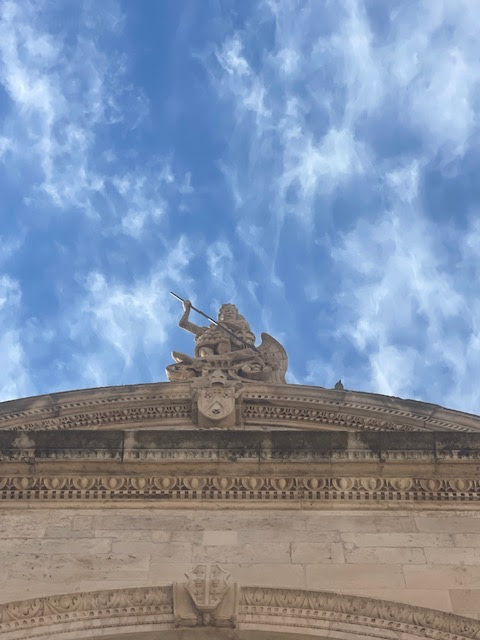
The Church of St. Mark. The coat of arms on the left depicts the three regions that comprise Croatia, and the one on the right is the seal of Zagreb. Note the old fashioned gaslight, one of 217 still in use throughout the city. It is the job of two city employees to light and extinguish each gaslight, every day.


A chapel inside the city's only surviving stone gate. The painting of Mary survived a fire in 1731 and the site today is typically crowded with the faithful.
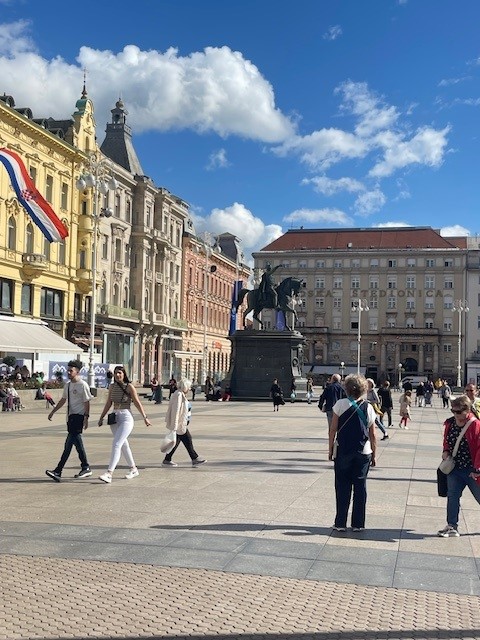
Jelacic Square, with a statute of the national hero astride a horse. He fashioned a substantial degree of autonomy within the Hapsburg empire. Under Yugoslavia, he was considered a dangerous symbol and the statute was removed. Jelacic resumed his place of prominence when Croatia broke away from Yugoslavia in 1991.


                                                                      The lively market. 


The cathedral. Like many other buildings in Zagreb, it is closed for renovation due to extensive damage suffered during a major earthquake in 2020. 


                                             Beautiful fountain in a lower town park, Zrinjevac.

Plitvice Lakes National Park

 Sixteen terraced lakes, connected by waterfalls, dot Croatia's first national park, Plitvice.


The views are stunning throughout. The lakes are grouped into 'upper' and 'lower', and both can be seen in the course of a few hours hike.

                                                                     The Big Waterfall


Wooden walkways and trails connect many of the lakes. Boat rides are popular although, depending on the season, a visitor might see more waterfalls by hiking.


                                                           A view from the top of the canyon.

Sibenik, Krka National Park, and Skradin

 Sibenik is a charming small town on the Adriatic coast. St. Michael's Fortress is well-preserved and serves even today an an open-air amphitheater.


The Cathedral of St. James was built in the 1500's of stone. The architectural features used in both the construction of the vaulted roof and the dome are unique and interesting.


              Now unused, the structure spanning the street was a trough to direct rainwater to a culvert. 


                                                                        The town square.


                           Krka National Park contains seven waterfalls, a monastery, and old mills.


 The water in Krka constantly moved, so the mills were always grinding. There is also a communal 'laundry' cave nearby where area residents would wash clothing well into the 1960's.

The observation deck below was built for the Emperor Franz Joseph I, who enjoyed viewing the waterfalls whenever he visited the region. 


                 Park visitors usually depart, following a brief boat ride, from the village of Skradin.

Split

Croatia's second largest city, Split, is a fascinating place. Amazing Roman ruins, a beautiful coastline, a wide variety of restaurants, and a host of boutiques and galleries hidden away in a warren of tight alleys--something for everyone!

 
Roman Emperor Diocletian, who ruled from AD 284-305, built and retired to a mammoth palace in Split. Today, it is home to thousands of residents and houses countless restaurants and shops, which nicely blend into the old stone walls.


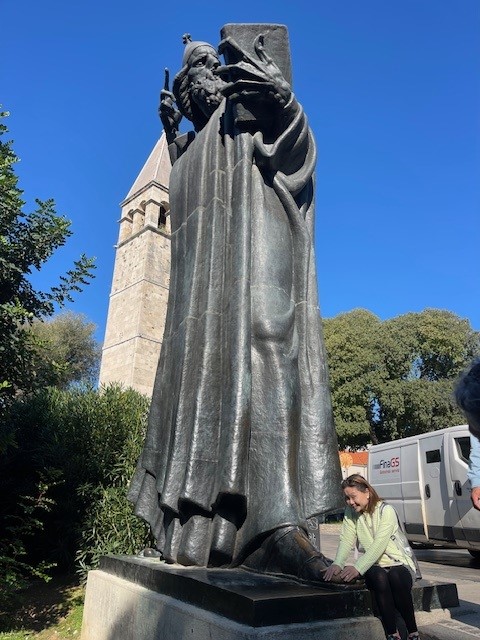
The statute of Bishop Gregory of Nin, a 10th-century Croatian who attempted to persuade the Vatican to allow sermons in Croatian rather than Latin. Today, those who seek good luck rub Gregory's toe.


                                 A residential area. One lady, now in her eighties, maintains the garden.


   The Peristyle, or main square, was the focal point of the Palace. Many of the pillars were brought from    Egypt.


The Emperor also imported thirteen sphinxes from Egypt; the black one above is the only one that is still substantially intact.


                                                                The Split open-air market.


                                                             Potent beverages are common!


                                                             The Cathedral of St. Domnius.


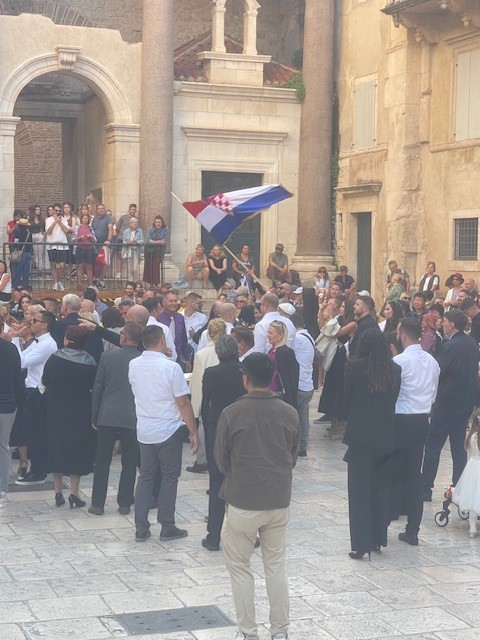
                    A Croatian wedding celebration in the Square, following a ceremony in the Cathedral. 


                                                               A few evening street scenes.