Friday, May 17, 2019

Saigon or Ho Chi Minh City

Ho Chi Mihn City, still commonly referred to as Saigon, is an energetic, rapid-fire, metropolis that never seems to sleep. Comparisons with Hanoi are inevitable, and they both share an evident love affair with the motorbike. Southerners claim that they are more friendly and open than northerners, which is difficult to judge during the course of a two-week trip. One thing for sure: a great time can be had in both places!

What is known as District 1 is home to most of the major tourist attractions. One gripping exhibit, however, is in District 3: The War Remnants Museum. The several intense exhibits are told from the perspective of the Vietnamese, and those which depict the effects of Agent Orange on citizens are heart-wrenching.


Captured American fighter planes

A re-creation of the infamous tiger cages, used to imprison men. The cages were of dimensions that made it impossible to stand, and those who survived were left with muscles so atrophied that they walked in a crab-like position.

Notre Dame Cathedral was erected by the French in 1880. Today, Vietnam has the fifth-largest number of Christian adherents in Asia.

The French Colonial Ho Chi Minh People's Committee (City Hall), housed in the former Hotel de Ville de Saigon

The colonial-style theater was built in 1899 as an opera house. It served as a national assembly hall during the Vietnam War, but is again a theater

My homage to novelist Graham Greene at the bar in the Continental Hotel, which featured prominently in his classic The Quiet American


The City Hall is beautiful in the evening

The city is wonderfully illuminated at night


But of course--a bustling central market

The Cao Dai temple is interesting because the religion is a blend of Buddhism, Confucianism, Taoism, Christianity, and Islam. 

A much larger temple complex may be found in Tay Ninh, and the religion is known for its colorful temples and processions

The Cu Chi Tunnels showcase how the Viet Cong used an extensive tunnel network to frustrate the American military. The tunnels capitalized on the small stature of the Vietnamese as shown by the tunnel entrance above. Once a soldier clambered down the ladder, a camouflaged wooden board would be lifted into place to completely conceal the entrance. 


Not ideal for an American standing over 6'2". 


Saigon is known for its street food

An embryonic duck, which tastes amazingly like a fine liver pate

Sharing food is commonplace
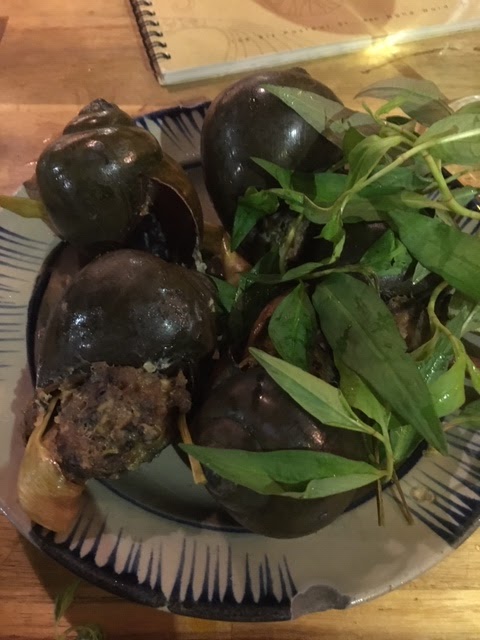
Snail shells stuffed with ground snail and pork were a true delicacy


Wednesday, May 15, 2019

Cham Museum, Hai Van Pass, and Hue

Danang, just north of the Marble Mountains, hugs the shores of the Han River and is a city quickly being transformed into a major tourist destination in no small part due to its stunning beaches. One popular attractions is the Cham Museum, originally founded by the French in 1919. On display are a variety of artifacts from the Kingdom of Champa, which was the dominant force in this region of Vietnam for over 1,000 years. The influence of Indian culture is apparent.


The city celebrates the bridges that span the river and are illuminated at night. Most noteworthy is the Dragon Bridge:


Hai Van Pass offers spectacular views of the East Sea and Truong Son Mountain Range, after a winding drive that includes several hair-pin turns. An army lookout at the peak shows plenty of scarring from shelling during the Vietnam conflict. 


                           Lang Co Beach is a beautiful stop on the drive between Danang to Hue:


On the shores of the Perfume River, Hue is an amazing complex. From within these walls, thirteen emperors ruled between 1802 and 1945. Although badly damaged during several conflicts, particularly the Vietnam War, restoration is in process and it is not difficult to imagine its former grandeur. The amazing complex spreads along three miles of waterfront. 


                       Restored Hall in the Forbidden Purple City. Several such hallways connected the      Imperial Family's palaces.


A short boat ride along the Perfume River takes one to the Thien Mu Pagoda, constructed in 1601, and the Tombs of the Emperors. I visited the impressive tombs of Khai Dihn and Tu Duc, although there are others in the area. 

Thien Mu Pagoda


A visit to Hue was one of the highlights of the trip. The sheer immensity of the Citadel complex was a surprise, and the number of noteworthy attractions in the area is a reward for any tourist. A don't miss visit!! 


Sunday, May 12, 2019

Charming Hoi An

Hoi An is a beautifully preserved and easily walkable town along the central coast. It's popularity makes it extremely tourist friendly, with an abundance of quality restaurants, massage parlors, and shops. English is widely spoken. The town was a center of commerce and home to several foreign communities, including the Japanese and Chinese. Today, evidence of their contributions to Hoi An society are evident in the fascinating bridges, buildings, and cuisine that any traveler will enjoy.


Cho Hoi An market, which sprawls across a wide area from the French-colonial central market to the river, makes for a great stroll. But be wary of the omnipresent bikes and scooters! 

Chinese Assembly Hall, built as a gathering spot for migrating Chinese


The Japanese Covered Bridge, originally erected in 1593 to connect the Japanese quarter with the Chinese neighborhood on the other side of the river. Japanese merchants were anxious to maximize trade. 

Entrance to the Covered Bridge


The Japanese Bridge at night 

View of bridge near the An Hoi night lantern market

Fishermen on the Thu Bon River--note the net slung over his right arm

One practiced motion...


I think we need a bigger net

Traditional "basket boats"

Water buffalo remain common in agricultural areas

Learning the basics of Vietnamese farming. To reach the farm, I rode a bicycle from Hoi An into the countryside. The scenery was beautiful, but exiting the city--involving several hand gestures by my guide and trusting in the reaction time of automobile drivers--was an experience. 

Toting water to my newly-planted crops