Tuesday, April 12, 2011

Prague: From Castle to Cafe

We were up early the next morning and joined our guide for a trip outside of the City to Konopiste Castle, a mammoth hunting lodge built by the Hapsburgs.  It is difficult to overstate the power and influence of the House of Habsburg and I never fully appreciated the extent of their empire until our visit to Prague and, later, Vienna.  The family's reign was essentially unbroken for over six hundred years, finally ending with the collapse of Austria-Hungary at the end of WWI.  A visit to Konopiste Castle, still stocked with the personal furnishings and effects of the Hapsburgs, gives one a glimpse into the lifestyle of a royal family that makes today's rich and famous seem like paupers.

Bear pit in the garden.


View from a upper balcony


BEAR!


Photography is not, unfortunately, allowed within the Castle and I can only hope to create some sense of what we saw.  One ornate and richly decorated room led to another and the walls were decorated with an incredible collection of artworks and tapestries.  Of course, being a hunting lodge, mounted animal heads were abundant.  In one long corridor alone, which I estimate was two hundred feet long, there was scarcely any space between the mounted heads of stags.  Apparently, Emperor Francis Joseph was a huge fan of the hunt and is reputed to have killed thousands of animals during his life.  Of course, a hunt for the Emperor meant that they'd set up a throne for him in the forest and servants would spend the day driving game to the Emperor and his party.  He even had a private shooting gallery built which featured an elaborate system of cranes and pulleys to manipulate various targets into place. 

We left the countryside and toured back to Prague for a visit to a few art deco style cafes, a Prague institution.  Fortified by caffeine, we then strolled through tree-lined Wenceslas Square, which slopes up a street full of shops until it reaches a statute of King Wenceslas on horseback.  Behind the King, and providing a beautiful backdrop for the Square, is the columned National Museum.


In front of Wenceslas Square.  These guys were part of the Prague Food Festival.


Perhaps the most stunning of all the sights in Prague, however, was the breathtaking Loreto, a place of pilgrimage with a baroque bell tower that has been chiming on the hour since 1695.  The Loreto Church is simply beautiful, with polished wooden pews, frescoed ceilings, and walls of marble hues that I did not know existed. 


Prague is chock-full of churches and a nice feature is that many host chamber music concerts for a small donation, both during the day and in the evening.  The result is that strains of classical music drift through the air almost everywhere and lend a magical quality to the experience.


We dined at Kampa Park restaurant, built right on the River Vltava, and the food and view were both spectacular.  We had arranged for a dinner table and, midway through the evening, were treated to a fireworks display over the River.  The food matched the display, and we enjoyed king crab on brioche, salmon caviar, and a main course of veal tenderloin with a morel cream sauce.  We strolled the cobblestone streets after dinner, the evening balmy and the lights bathing Prague Castle in an enchanting glow.  Linda relented and agreed that I could indulge in another absinthe before packing our bags.  I believe, in fact, that I had more than one, to soften the blow of departing such an engaging City--one that definitely warrants a return visit.
Kampa Park, best restaurant of everywhere, so far.


Isn't Michael clever?!  Fireworks for our anniversary!

Monday, April 11, 2011

Prague: A Step Back in Time

We selected Prague more as a convenient stopover on a trip between Paris and Vienna than for any other reason, and were both surprised and elated at what we found.  Spared from the devastation that ripped through many other European cities during WWII, Prague is a charming gem of a place, an exciting and incongruous blend of the medieval and the modern.  A city of 1.3 million inhabitants, it is bursting with ideas and hope after too many decades stunted by the pallor of communist rule.  As our lovely guide, Martina, explained; "My father had to reason to try anything.  He was given a job, and the man in the booth next to his made exactly the same whether he worked or not.  Now, everyone wants to do something different and be their own person."

While there are certainly some ugly architectural relics from the communist era, there are many more churches, castles, squares, and even houses that have been preserved from medieval times.  A good place to begin is a walk along cobblestone streets, lined with shops and full of tourists, to the storied Old Town Square.  Amble around and take in colorful buildings of every shape and size that seem like something Disney might try to design.  Don't miss the Astronomical Clock, constructed in the fifteenth century, that features twelve sculpted apostles appearing on an elevated platform every hour. 

A great place to soak in the ambiance of the Square is at the Hotel U Prince Bar.  Linda and I were given an outdoor table and sat for some time just enjoying the parade of people strolling about.  A helpful tourist tip: Czech law forbids street vendors from talking to or otherwise harassing anyone.  They can stand and point at whatever they're hawking, but that's it.


Absinthe!


Great people watching.

The "lads" were dressed for the world rugby cup.

We stayed at the Four Seasons Prague and were very pleased with the choice.  It is not far from the Old Town Square, right on the bank of the Vltava River that separates Old and New Towns, and only a block walk from the famed Charles Bridge.  The Bridge, erected centuries ago, is dominated at both ends by huge and ornate towers.  Along the Bridge, on both sides, are more than thirty sculptures of saints.  A stroll over the Bridge, particularly in the evening glow of the City's lights, is a delightful experience.  The night skyline is dominated by the mammoth Prague Castle, said to be the world's largest, which is perched atop the highest point in the City and glows beautifully in the evening under soft golden lights.

The "Green Fairy" again!  Oh no Michael!

Hotel U Prince Bar at night with entertainment.

Looking back on the Charles Bridge.

Looking into Old Town.


We visited the Castle on our first day and were overwhelmed by its sheer size and complexity.  A warren of twisting alleys, more buildings than we could count, and all connected by three huge courtyards sprawling over 112 acres.  The highlight was St. Vitus Cathedral, with so much intricate detail on the interior that it was difficult to comprehend all of it.  The stained glass windows were among, if not the most, beautiful we had ever seen.

We dined at the Blue Rose restaurant and thoroughly enjoyed both the cuisine and the decor.  The restaurant is essentially a below-ground brick cellar with a vaulted ceiling.  We learned that there are many such structures in Prague, as the city--over centuries--has built atop older buildings to avoid river flooding.  These cellars--now restaurants, clubs, or storage facilities--sometimes descend for three stories.  The most bland of surface establishments may sit atop a fascinating hive of underground surprises.  For dinner, we enjoyed a Trivento, '05 Reserve Malbec, with a fine meal.  We had cream of asparagus soup with shrimp and escargot.  Linda's main dish was pork tenderloin wrapped in bacon and stuffed with pears and apricots.  After dinner, we adjourned to the hotel bar where I imbibed one too many glasses of absinthe and dreamed of what we might see on the 'morrow.


Friday, March 4, 2011

Catalonia!

Our guide, Lila, met us at the hotel lobby.  While we waited for Linda, I asked her if it was okay if I tried speaking with her in Spanish.  She said that would be fine, but seemed slightly hesitant. I found out why later in the day. 

The tour was great and we saw some fantastic sites.  Lila was very knowledgeable and loved sharing details of her beloved Barcelona with us.  We toured the Sagrada Familia, designed by the famous architect Gaudi, and marvelled at the fantastic details of the edifice.  Construction was on-going, and will be for some time, to judge by the ambitious plans for further expansion.  Some criticize these plans, contending that they far exceed Gaudi's vision, but none can deny that the ultimate effect will be more surreal than any other structure.  Like it or not, it is certainly something different and well worth a visit.

                                                              Ceiling and columns
So, too, is Park Guell, designed by Gaudi.  A sinuous multi-colored bench he designed, which wraps around a clearing in the park, affords stunning views of the City.  Walkways suddenly turn in to tunnels, with astonishing columns supporting the ceiling.  The park was full of families and tourists and carried a very festive atmosphere.


We lunched at the time-honored 4 Gats (Catalan for 'cats'), with tiled floors and dark panelling.  Four young artists established the restaurant and Picasso had his first exhibition there in 1900 at the age of 18.  Lila joined us for lunch and we talked extensively of the Catalonia's history and culture.  She explained that she was pleased to speak Spanish with me because I had asked politely.  Normally, she refuses to speak in any language but Catalan. She views the region as Catalonia, not really Spain except for the political affiliation, and believes that people should speak Catalan and not Spanish when in Catalonia.  For example, many Argentines immigrated to the Catalan region in 2001-2002 when Argentina was experiencing its economic crisis.  Lila will not speak Spanish with them--if they settle in Catalonia, she believes it is there obligation to learn Catalan.

They teach little Spanish in Catalonia's schools, a sharp contrast to the days of Franco when he repressed all things Catalan.  Signs are  typically bilingual or in Catalan.  It is an interesting language, with ten vowels.  Lila noted that it is not related to Basque, which is incomprehensible to them.  There is also a fourth common language in Spain, Galicean, near Portugal, but it is really a romance language and not a Portuguese dialect.

Fortunately, we were in Barcelona as the Festes de la Merce began, an annual festival unique to the Catalan region.  Huge wooden costumed figures are paraded through the streets and performances and contests abound  I visited the Plaza San Juame (St. James Square) in the middle of the Gothic quarter--a truly fascinating section of twisting, narrow, cobblestone streets--and watched the castellers compete.  The idea is to form human pyramids as tall as possible and it was amazing to watch the men interlock arms as other climbed atop them to, again, interlock arms while a third layer clambered aboard.  They would reach 6-7 stories high, with young boys being the last to make the dizzying climb to the top.  One pyramid collapsed as we watch, the crowd gasping, but they all seemed to slowly tumble in a heap and no one appeared injured.  The entire contest has a medieval feel to it as each team wears uniforms of different colors and all parade before the crowd, packed into the aged square, prior to the competition. 


Lila introduced us to carajillo, a coffee flavored with brandy.  The same concoction with milk is called a trifasico.  Either one is a magnificent way to end a lunch.   The meals in Barcelona were memorable and I'll mention a few restaurants of note: Alkimia was and we had a multi-course meal that exceeded expectations.  Cured ham paired with a glass of olive oil, mussel soup with cheese, pickled oyster with spinach and pork cheek, caviar atop bone marrow, a soft-poached egg bonbon, shoulder of young lamb--how we ate it all I'll never know.  We ended with dessert of black chocolate with rum and raspberry cream, over coconut ice cream.  This was paired with a Pedro Ximenez Tradicion Jerez, a dessert wine that tasted almost like Kahlua. 

Another restaurant not to miss is La Dama, one of those rare restaurants where the setting is as spectacular as the food.  Housed in an art deco building, the details are truly spectacular.  Don't miss the art deco elevator in the lobby which is a gleaming design of pure whimsy. 

The final restaurant I'll mention is Los Carrcoles, established in 1835.  The dark wood and mirrored bar is decorated with slabs of cured ham strung from the low ceiling.  The small dining room has colorful tiles on the walls and a dark, beamed ceiling.  Food was great, including a delectable serving of razor clams.  For dessert, we ordered trifasico and they left the bottle of rum on the table for us to pour as we pleased. 


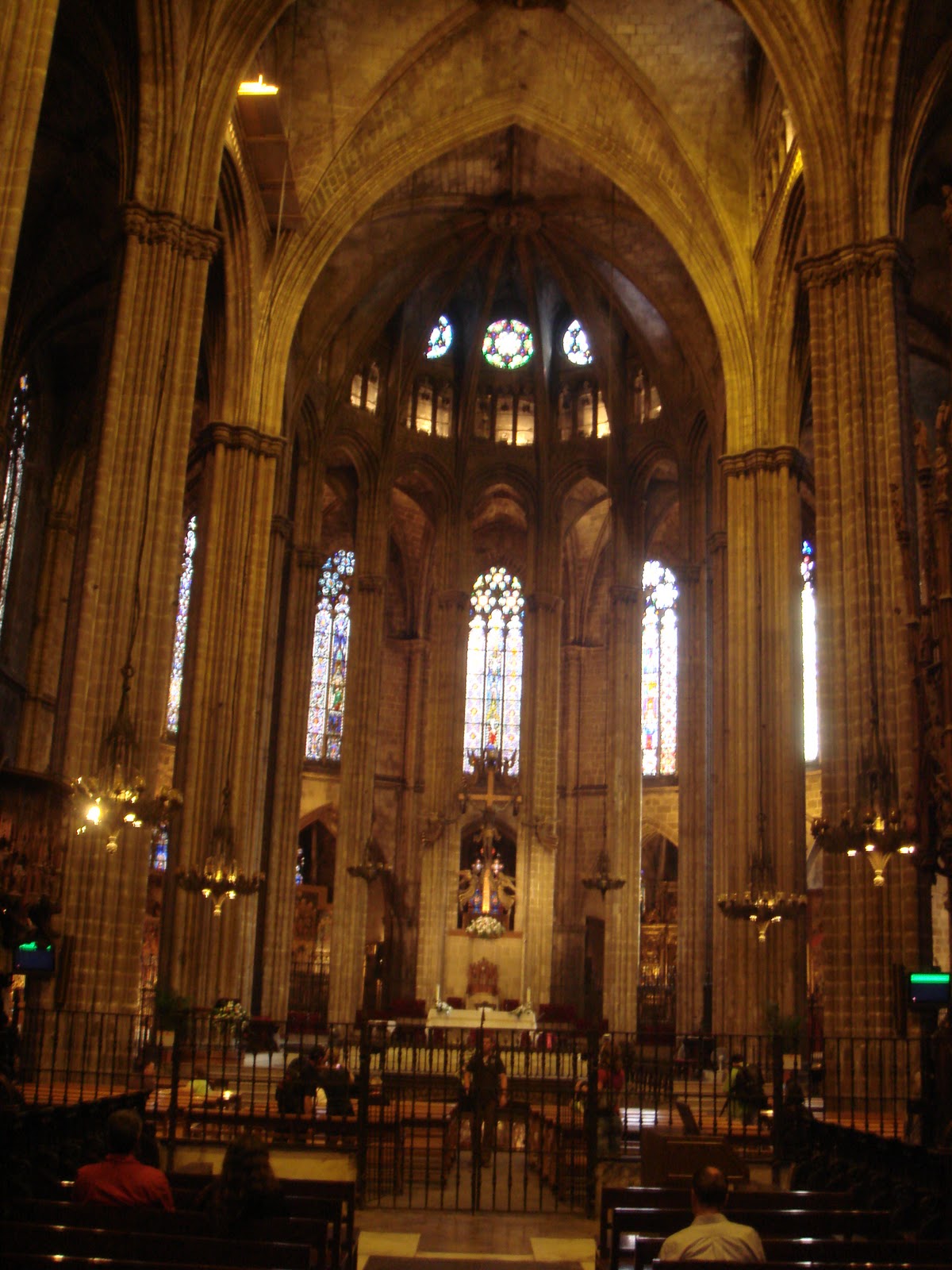
Our final two tourist sites were the Tidabo, a mountain looming 1600 feet over the City and providing a beautiful panoramic view.  Tidabo was the location of the 1992 Summer Olympics and the buildings constructed then, such as the pool, are now devoted to civic use.  We then toured the magnificent Cathedral, reminiscent of Westminster Abbey, particularly with respect to some of the ceiling architectural details.  The choir area is stunning and we enjoyed the pond in the courtyard, with its swans and turtles, as well.