Thursday, November 9, 2023

Seville

 Seville, Spain's fourth largest city, embodies the definition of a vibrant urban area. The city has an infectious energy and its two major attractions, the Cathedral and the Alcazar, do not disappoint. 

The Cathedral's Giralda Bell Tower soars 330 feet and was originally built by the Moors as a minaret from which a muezzin could issue the call to prayer.

The Cathedral is the third-largest in Europe, after St. Peter's and St. Paul's. It is the largest Gothic church in the world and the interior area is larger than any other.


                                         The high alter features an organ of more than 7,000 pipes.


                                           The ceiling detail and craftsmanship are extraordinary. 


Below is the tomb of Christopher Columbus, whose remains were transferred to the Cathedral from Cuba in the early 1900's.


The Treasury houses magnificent items, including a 1,000 pound silver-plated monstrance used to display the communal wafer.

                                                            Note the amazing oval dome. 


The Alcazar is similarly amazing. Originally built in the 10th-century as a palace for Moorish governors, today it is the oldest royal palace in Europe.


When King Pedro assumed the throne in the 14th-century, he engaged Muslim workers from Granada to duplicate the grandeur of the Alhambra. Below is the ceiling in the Hall of the Ambassadors, where Pedro would receive guests.


The Mudegar style used by the Moorish workers is particularly interesting here, as they blended traditional Moorish and Christian elements of design and ornamentation.


                                                    The elaborate gardens are not to be missed.


Seville hosted two World Fairs--well, almost. The first was planned for 1929, but was derailed when the stock market crashed. The second occurred in 1992 and was a great success. Many of the pavilions and buildings constructed then remain in use today.


The Plaza de Espana, designed as the focal point of the 1929 World's Fair, is covered with glazed tiles depicting famous historical moments in each of Spain's 40 regions. The unique site appeared in Star Wars: Attack of the Clones.


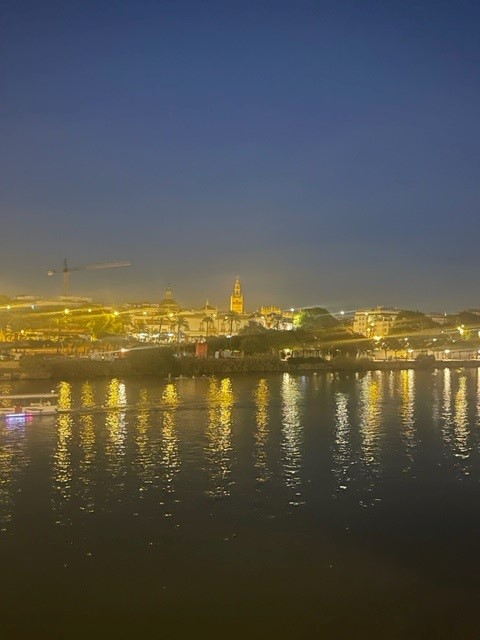
A nighttime stroll along the Rio Guadalquivir offers a wide variety of restaurants and stunning views.



Wednesday, November 8, 2023

Jerez: Sherry and Stallions

The Marques del Real Tesoro and Valdespino wineries provided a great opportunity to learn about the tradition of sherry making in Jerez. The casks signed by world notables were interesting, as was the sheer magnitude of the storage facilities. 


The winery houses a private art gallery, home to a Suite Vollard, commissioned by the dealer Vollard and eventually consisting of more than 100 etchings made by Picasso between 1930-1937. 


                                                             An early study for Guernica.


            The Royal Andalusian School of Equestrian Art presents a fascinating show of equestrian ballet.


                         The timing, training, and capabilities of riders and horses are astonishing. 


Santiponce

 Not far from Seville is the small town of Santiponce, remarkable for two reasons. The first is the spectacular Roman ruins, including the an amphitheater once capable of seating 30,000 people. The underground corridors, once teeming with gladiators and animals, are fun to explore.


The second reason to visit is the talented Marmolejo family, artisans who have continued the family craft through generations. They make many of the beautiful items seen in Catholic processions and a municipal museum recognizes the family's amazing abilities and dedication.


The below drawing, depicting the interior of a prison during the Spanish civil war, was sent to the family by an incarcerated relative. Although he told the family that he was being treated well, he was never seen again.


Our visit concluded with a delightful meal, complete with some terrific Iberian jamon!!


Granada

The Alhambra definitely lives up to its billing as one of the most remarkable structures in the world. The greatest--and last--Moorish palace provides a window into the eight centuries when the Moors ruled Andalusia. Above, the Grand Hall of the Ambassadors. The wooden ceiling is crafted from more than 8,000 inlaid pieces.


Detailed ceiling murals provide a glimpse of life during Moorish rule. Note that Islamic doctrine, while not permitting the portrayal of icons, does allow the depiction of secular figures. 


                                                               The Courtyard of the Lions


The Hall of the Abencerrajes, the sultan's living room. The ornate design is based on the eight sides of the Muslim star.


               Washington Irving worked on Tales of the Alhambra while living in this room in 1829.

                                           The view over the old Moorish town, the Albayzin.

                                            The elaborate Gereralife gardens are a tranquil oasis.


                           The streets of Granada are lively and beautiful architecture is everywhere.


The renaissance Cathedral and Royal Chapel do not, unfortunately, allow photographs. The Cathedral is the second-largest in Spain (after Seville's) and the Royal Chapel houses the remains of Queen Isabel and King Ferdinand. It was during their reign that the reconquest of Andalusia from the Moors finally succeeded, with the surrender of the Alhambra, and they chose Granada as their final resting place.

The old Moorish quarter of Albayzin is a delight to wander; many of the streets are too narrow for vehicular traffic.


                                                                A communal water fountain.

                              The St. Nicolas viewpoint offers dramatic views of the Alhambra.


The Sacromonte District is the home of Granada's thriving Roma community. It is a very compact, steep, area with only one main street. Caves which have housed Roma for generations are now equipped with electricity and water. While several continue as residential properties, many are now restaurants and tourist stops. Some offer zambra shows, the local variant of the flamenco.