Wednesday, February 12, 2020

Galapagos!

We flew from Quito to the Galapagos, and went directly from the airport to the pier for a brief dinghy ride to the Galapagos Legend cruise ship. The Galapagos were discovered by Europeans in 1535, but left largely undisturbed until the 17th century when they became the base for English, Dutch, and French pirates. The best known pirate, of all who frequented the islands, is likely the Englishman, Sir Francis Drake. Regrettably, for the giant tortoise population, they were an ideal food source for the pirates. Able to survive for long periods without food or water, the tortoises were loaded into ships' holds to serve as a source of fresh meat. The population was decimated, and the trade in fur seals, sold for their pelts, also spiked. Ecuador claimed the islands in 1832.


The islands were declared a national park in 1959, and tourism began to increase. However, commercial fishing also increased dramatically and fish stocks dwindled. In 2001, UNESCO designated more than 100,000 square kilometers around the islands as a World Heritage Site. Tourism increased to the point that the sheer volume of visitors was overwhelming. In 2007, UNESCO placed the islands on the List of World Heritage in Danger. The government restricted immigration to the island, began to seriously enforce fishing limitations, and also imposed limits on tourism. In 2010, the islands were removed from the "in danger" list.


Dinghies were our daily mode of transport for our wet or dry landings. "Wet landings" involved stepping into the ocean and wading ashore, while we progressed directly onto rocks or a dock for "dry landings." We visited the islands of Santa Cruz, Santiago, Isabela, and Fernandina.


                                A land iguana didn't care how we arrived. He owned the path!

 
Writing prompt: what happened to the backpacker?

 
Majestic sea lion at sunset. One bull has a harem of females which he jealously protects from intrusive males.
 

                          Fauna is also very diverse, with several species of cacti in abundance.

 
Pink flamingos


                                                               A natural land bridge


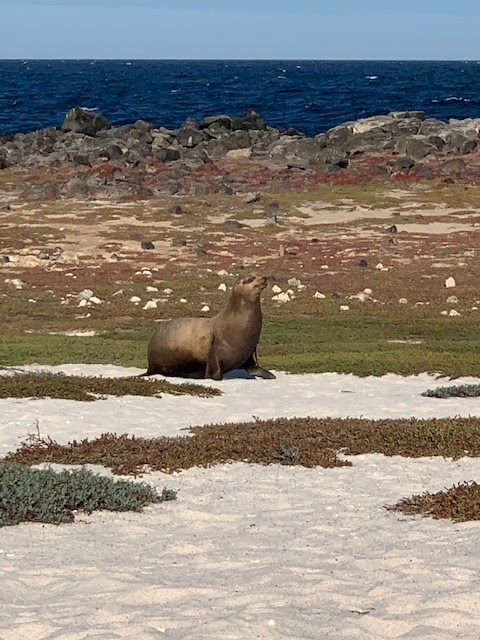
                        Female at rest. We were allowed to approach as close as six feet to the animals, which have no fear of humans because no hunting or trapping has been allowed for years.


Whale skeleton on Bachas Beach


Each island has its own distinctive beauty, and the wildlife sightings are simply spectacular. Invasive species--primarily pigs, goats, and rats--wreaked havoc on the islands for years but efforts to control and eradicate these animals have seen significant success.


Saturday, February 8, 2020

Quito and Mindo

Quito, Ecuador, at 9,350 feet above sea level, is the second-highest capital city in the world, after La Paz, Bolivia. With only a few days to enjoy this city of nearly two million people, we spent much of our time in the warren of narrow, winding streets in the Old Town district. Although parts of this section are gritty, and crime is definitely an issue, there is an overriding charm to Old Town that makes for a delightful visit.


                             There are an abundance of beautiful colonial churches in Old Town.


                 The Plaza Grande is surrounded by striking, colonial era governmental buildings.

La Compania is arguably the grand dame of all of Quito's churches. Photographs are forbidden inside, but the interior is even more spectacular than that of the Iglesia San Francisco, below.

A view of the sanctuary

The ceiling in the choir loft


                                                 The exterior of the Iglesia San Francisco

 
The Virgin of Quito, atop El Panecillo, is constructed of aluminum. Always protecting the city, she stands atop a serpent. A replica of a famous wooden sculpture, the one depicted here is the only statute of a winged Virgin.
 
 
View of Quito from El Panecillo

 
Quito is the capital city nearest the equator, referred to here as Mitad del Mundo (Middle of the World). The precise location of the equator is the topic of some dispute. A large monument supposedly marks the spot, but it is generally acknowledged that it was misplaced!

 
From Quito, it is a beautiful drive through the mountains to reach the charming city of Mindo. The chocolate industry here is thriving, and we enjoyed a tour--as well as the opportunity to sample products--at one of the local shops.


A ride in a cable car provides a great opportunity to enjoy the scenery and the abundant bird life. Ecuador has one of the largest bird populations in the world, and the greatest number of hummingbirds.


Near the Mitad del Mundo is the Pululahua Reserve, nestled inside an extinct volcano crater. Several farmers reside in the fertile basin, and it is believed to be the largest inhabited crater in the world.


Travelers should note that Quito is only about a four hour flight from Atlanta, and boasts a modern and efficient airport.
 

Thursday, October 24, 2019

Halifax, Nova Scotia!


Halifax cannot match the ambiance of Quebec City, but it has a rugged charm all its own. Set on rolling hills above the harbor, one is never far from the water in Nova Scotia--and the stunning vistas prove it!

We began our trip, however, with a vista of a different sort--the Alexander Keith Brewery. Founded by its namesake in 1820, and now part of the Anheuser Busch InBev conglomerate, the brewery offers a great tour. Generous pours, music, and a nice atmosphere.


The waterfront has a carnival-like atmosphere along the popular Harbourwalk, with attractions for children and adults alike. There are a slew of restaurants and bars, and the waterfront setting can't be beat.


The action continues late into the evening


The harbor does have a dark history, as it was the site on what was, at the time, the largest man-made explosion in history. A Norwegian vessel collided with a French ship laden with explosives and a fire erupted, which soon set off the munitions. Approximately 2,000 people were killed, and more than 9,000 injured. 

The lighthouse at Peggys Point, near the popular tourist destination of Peggys Cove, provides sweeping views of the Atlantic 


It is a good idea to heed the warnings!! 

But there is always someone who breaks the rules!!


This monument is in memory of Swissair 111, which crashed into the ocean with the loss of 229 souls

A stop in Lunenburg for a distillery visit

On a more somber note, a memorial at Lunenburg to those who have lost their lives at sea

Colorful buildings are common in Lunenburg


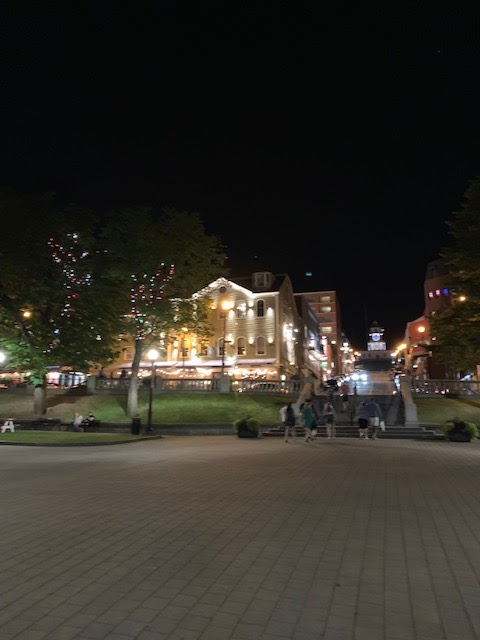
                                                    Beautiful downtown Halifax at night