Surprise! The ferry had left. No one told us that there was a one-hour time difference between Argentina and Uruguay during the time we were visiting. Luckily, there was one more ferry which would depart early evening, so Linda and I did our best to turn a lemon into lemonade. We reclaimed our golf cart and headed to the Yacht Club to wile away a couple of hours. There was an open table outside on the deck, and a young tuxedo-clad waiter promptly took our order for a couple of martinis. Unfortunately, he--or the bartender--had an unwarranted affection for vermouth. Our waiter's brilliant solution to making sure we had the cocktail we wanted? He wheeled a cart to our table with a bottle of vodka, vermouth, olives, lemon, ice, and chilled glasses. We had a make-your-own martini fiesta while watching a brilliant sunset over the harbor. Neither of us regretted missing the earlier ferry, although I confess that my ability to navigate the golf cart may have been somewhat impaired when we finally departed. At least, I think I drove.


Our next excursion to Uruguay was at the end of our trip. We flew into Montevideo, the capitol, intending to spend a night before heading south to the popular resort area of Punta del Este. We had arranged for a driver to meet us and take us to the hotel we'd booked downtown. At the airport, we spotted Air Force One and were reminded that President Bush was visiting Uruguay at the time. Uruguay has a democratically elected socialist government, and one that is on good relations with the United States. We headed downtown only to discover that our hotel was cordoned off--the President had, essentially, taken it over. Our driver spoke to a guard--I don't trust my Spanish enough to try and communicate with men carrying guns--and explained the predicament. The guard called for someone to relieve him, took our passports, and said he would accompany us to the front desk. I wasn't feeling particularly good about our prospects for a room.
The staff at the front desk advised that they were sorry they had been unable to reach us (I don't think anyone ever tried) but that they'd arranged for a room at another hotel downtown, called the Crystal Palace. Linda was rather insistent that we be given the room we had booked but, as I gazed about a lobby overflowing with secret service agents and local security personnel, all heavily armed, I discouraged any argument. The driver drove us to our new hotel and I learned that Crystal Palace translates into 'hellhole', or some similar term. The location was in a rather seedy area of Montevideo and the room had a distinctly musky aroma reminiscent of moist gym socks. Our solution was to ask the driver if he'd take us directly to Punta del Este, about an hour and a half drive. He agreed, and we left behind President Bush and the Crystal Palace.
We called the Hotel Conrad, where we'd arranged to stay, and confirmed we could arrive a night early. The Conrad is a venerable hotel/casino that receives mixed reviews from travelers. I would recommend it for first-time visitors to Uruguay. Most of the staff speak some English, it has the amenities of a large hotel, and a central location within easy walking distance of beaches and shopping areas. The hotel's own beach is rather small, but it has a large outdoor pool.


Punta del Este was a great place to visit. It is THE place where wealthy South Americans, particularly Argentines, go for summer fun. The town is situated on a peninsula bounded by the Atlantic on one side and the wide expanse of the Rio de la Plata, which separates it from Argentina, on the other. Beautiful sand beaches rim the peninsula. We were there in September, when the summer crowds had dissipated, but the weather was still great and we had no trouble finding seats in any restaurant we wanted. Like Argentina, Uruguay is a country populated with people of European descent--88%. mostly Italian and Spanish. Also like Argentina, this influence shows up in their food and we had some spectacular Italian cuisine during our visit. One tiny spot, Scarlett, overlooking the ocean and decorated with posters featuring Gone With the Wind characters, served a delectable black squid ink pasta.


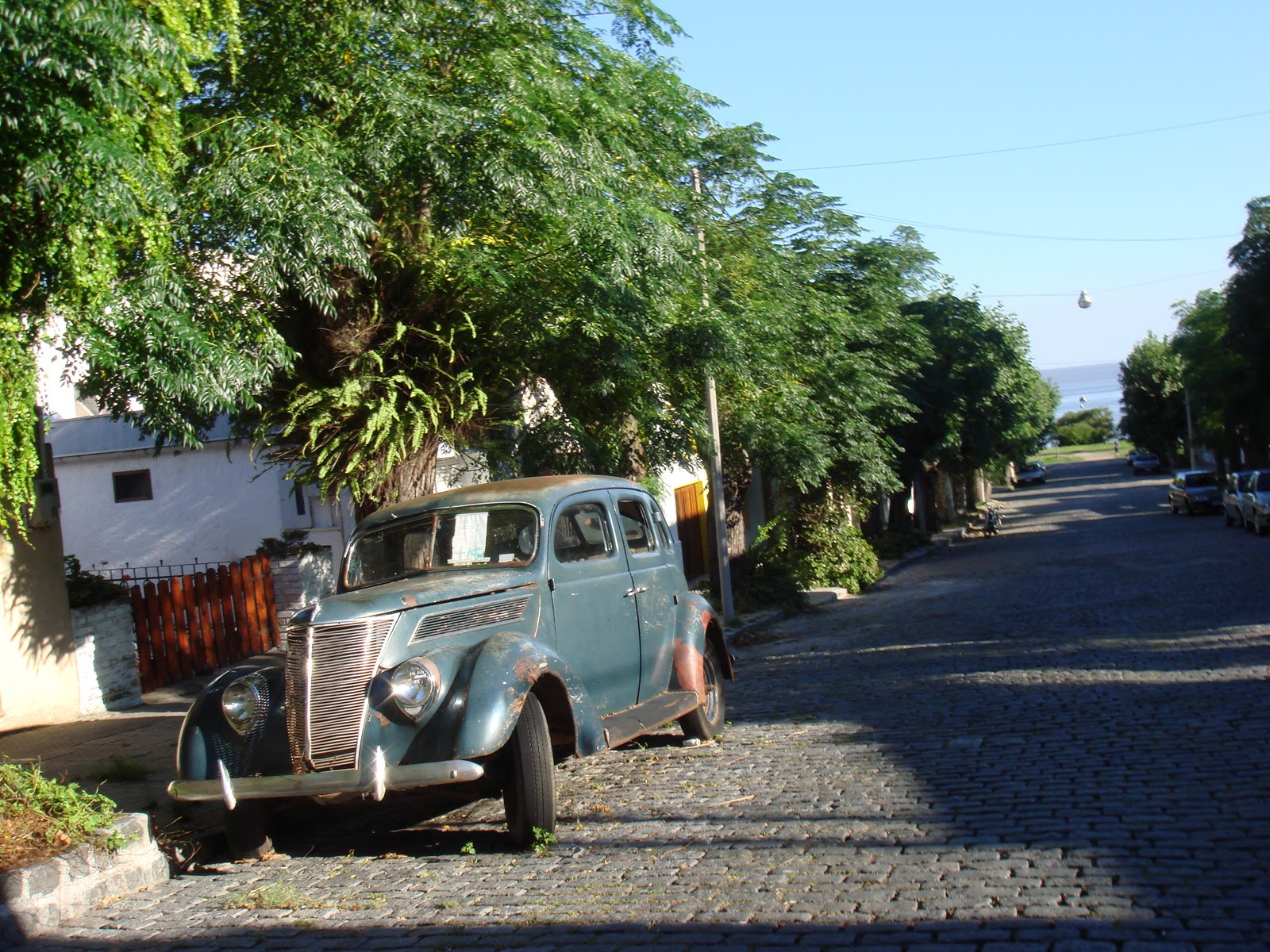
Some things about Uruguay really stood out. First, it is a tiny nation. The total population, of which more than half live in Montevideo, is about 3.5 million. Indeed, they don't have street addresses in Uruguay. You give your house a name--say, 'House of Flowers', and your mail will be addressed to House of Flowers, Main Street. They have an affinity for old American cars, like Packards, and you'll see a few of those tooling around. They view Argentina as an arrogant older brother and debate which country makes the best dulce de leche or consumes the most mate, per capita.


yerba plant are ground and hot, nearly boiling water, is poured over them. The tea is then consumed from a gourd through a straw. Any visit to an Argentine home commences with the passing of the mate gourd, from person to person, all using the same straw. Only after mate is consumed will any other beverages be offered. Some of the gourds are quite ornate, decorated with silver, for example, and are often passed down from generation to generation. In the mate consumption contest, however, I give my vote to Uruguay. People drank mate everywhere, and most gas stations we saw had a machine that would dispense hot water so people could replenish their mate cup, gourd, or whatever they'd be drinking from.
We drove the coastline away from Punta del Este on our final day in the country and saw some truly fantastic scenery. Miles of deserted beaches, a few charming small communities and, inland, a verdant landscape of gently rolling hills. Our sharp-eyed driver spotted a tarantula in the road and stopped for a bit so we could observe the creature first-hand. We were content to keep our distance as the tarantula eyed us warily but held his ground until we departed. We continued through vast expanses of range--like Argentina, cattle is king--and returned for a final night in a charming country. Over a steak dinner, we enjoyed a bottle of tannat wine, a grape which we understand is grown only in France and Uruguay, and rued the fact that our trip was rapidly drawing to a close.

The famous Punta Del Este hand sculpture on the beach.

The sway back bridge.


This museum-restaurant-hotel was hand built by the famous Uruguayan artist, Carlos Paez Vilaro


We drove to Montevideo the next morning, with time to stop at the famed Central Market for lunch. I enjoyed my last chivito, a sandwich consisting of thinly sliced steak, ham, egg, olives and cheese. The sandwich alone is worth a trip to Uruguay albeit it may also cause a trip to the cardiologist.


We spent our last night in South America at the new Park Hyatt, and it was spectacular. Easily the best Park Hyatt we've seen, constructed in part by incorporating the former palace of a wealthy Argentine family. The ultra-modern rooms, with state-of-the-art technology, contrasted with the ornate marble floors and European sculptures that decorated the common areas. We regretted that we'd be spending only one night.


Our flight came too early the next morning and we had our last look at Buenos Aires as the cab took us to the International Airport. Someday, I promised myself, we'd return. As I write this, it is impossible not to miss the passion of the tango, the richness of the culture, the stunning beauty of waterfalls, of sunsets, of the people themselves. Yes, someday, for another sip of mate, a taste of dulce de leche, a meal of steak and malbec and, most importantly, to see a friend from long ago. A combination that makes a journey one to savor.