Friday, November 8, 2024

Split

Croatia's second largest city, Split, is a fascinating place. Amazing Roman ruins, a beautiful coastline, a wide variety of restaurants, and a host of boutiques and galleries hidden away in a warren of tight alleys--something for everyone!

 
Roman Emperor Diocletian, who ruled from AD 284-305, built and retired to a mammoth palace in Split. Today, it is home to thousands of residents and houses countless restaurants and shops, which nicely blend into the old stone walls.


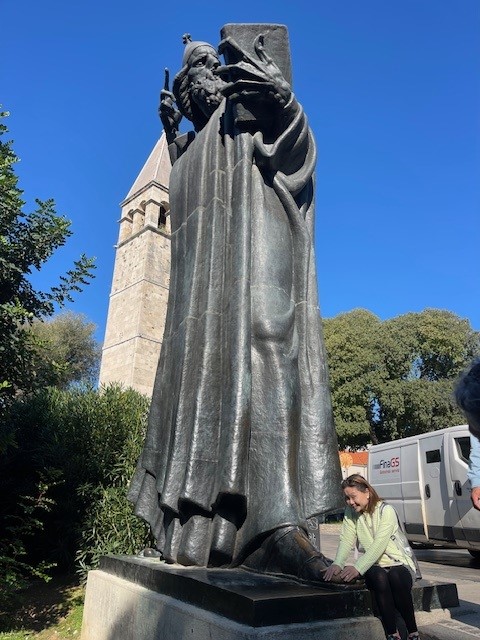
The statute of Bishop Gregory of Nin, a 10th-century Croatian who attempted to persuade the Vatican to allow sermons in Croatian rather than Latin. Today, those who seek good luck rub Gregory's toe.


                                 A residential area. One lady, now in her eighties, maintains the garden.


   The Peristyle, or main square, was the focal point of the Palace. Many of the pillars were brought from    Egypt.


The Emperor also imported thirteen sphinxes from Egypt; the black one above is the only one that is still substantially intact.


                                                                The Split open-air market.


                                                             Potent beverages are common!


                                                             The Cathedral of St. Domnius.


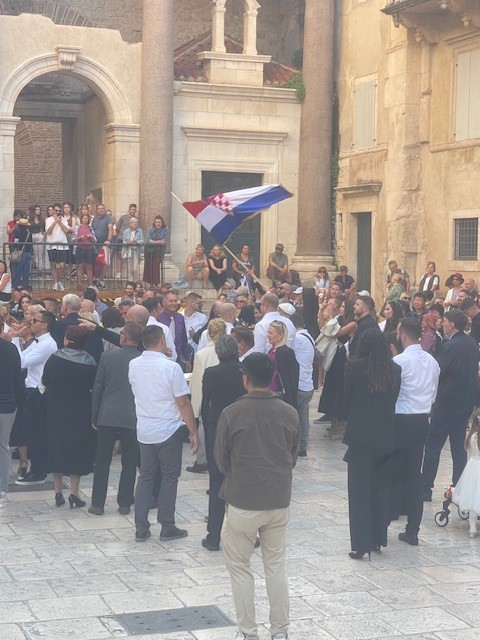
                    A Croatian wedding celebration in the Square, following a ceremony in the Cathedral. 


                                                               A few evening street scenes. 


Hvar Island

 Now a favorite of the jet-setting crowd, Hvar is a charming island that has played an important role in the production of lavender and wine. Today, tourism is the dominant industry. No surprise, given views such as those below.


                                   The 2,400 year old town of Stari Grad seen from a distance.


The bust of poet Petar Hektorovic stands in front of his former palace, which featured a canal running through it. Today, the property is privately occupied and not open to the public.


Vrboska, or Little Venice, features a canal spanned by bridges, some of which are hundreds of years old.


Views from Napoleon's Fortress, which was built in 1812. The French ruled Croatia from 1806-1813 when Napoleon's troops were defeated by the Russians and the Austrians occupied Croatia


                                                      A farewell sunset view from the Harbor.


Ston and an Oyster Experience

 A fascinating Croatian town is Ston, known for its impressive walls as the "European Great Wall of China." Built in 1358 to protect the salt deposits that were a major source of Dubrovnik's wealth at the time, the walls contain 40 towers and 5 fortresses.


The famed Mali Ston oysters are the other highlight in Ston, and a boat ride in the harbor to enjoy a lunch of mussels and oysters (with wine!) at an oyster farm should not be missed.


Dubrovnik

 The walled city of Dubrovnik evokes images of armored soldiers and heroic battles, and would do so even if Game of Thrones had not been filmed there. This "Pearl of the Adriatic" is a visually striking town of just over 40,000 residents.


                                           The Fort of St. Lawrence, Dubrovnik's oldest fortress.


                                                   A figure of St. Blaise, protector of Dubrovnik


Centuries old etchings, in Latin, admonishing children not to kick balls against the monastery wall.


The map shows where bombs were dropped by the Yugoslav People's Army during the 1991-1992 Siege of Dubrovnik, which lasted seven months and resulted in the deaths of more than one hundred civilians. While the old walls held, they could not provide protection from a tool of modern warfare: the airplane. 


                                                                  View of the Old Port


Nearly two-thirds of the city's rooftops were damaged during the siege. They were replaced using the original techniques, but stand out due to a brighter red coloring.


                                                                      The marketplace.


            Church of St. Ignatius of Loyola, at the top of a grand staircase leading from the marketplace. 


                                                                    View from Mt. Srd.


                                               View from the Panorama Restaurant atop Mt. Srd.