If there is a more beautiful island than Santorini in the Aegean, I haven't seen it. As we cruised into the bay, nestled in a volcanic crater, or caldera, our view encompassed cliffs soaring over 1,000 feet and dotted with the stark white villages of Fira and Oia high above. There are three ways to approach Fira: by funicular, by donkey along a steep, switch-back pathway, or by walking that same pathway. As walking seems an option only for the masochistic, most of our group opted for the funicular or one of the rather forlorn-looking donkeys.


To be candid, both Fira and Oia are the epitome of tourists towns, with street after street lined with restaurants and souvenir shops. However, it doesn't matter: the views are undeniably spectacular. Nothing constructed by man could detract from the view of endless shades of blue water, billowing white clouds, and the specks of islands that rise from the sea. Let the cruise ships descend, let the tourist throngs pack the narrow streets, let the souvenir hawkers bark their loudest--the rapturous views from the peaks of Santorini will prevail.
We lunched at Selene restaurant, in the village of Pyrgos, and would recommend it to anyone for its creative cuisine and breathtaking vistas. We engaged a guide to meet us at the restaurant and show us the island highlights. Unfortunately, we had wanted to visit the renowned archeological site of Akrotiri, but it was closed due to a two-day strike by public workers. There was, nevertheless, a variety of interesting sites to visit.
Seafood crocuettes
Octopus
Shellfish pasta
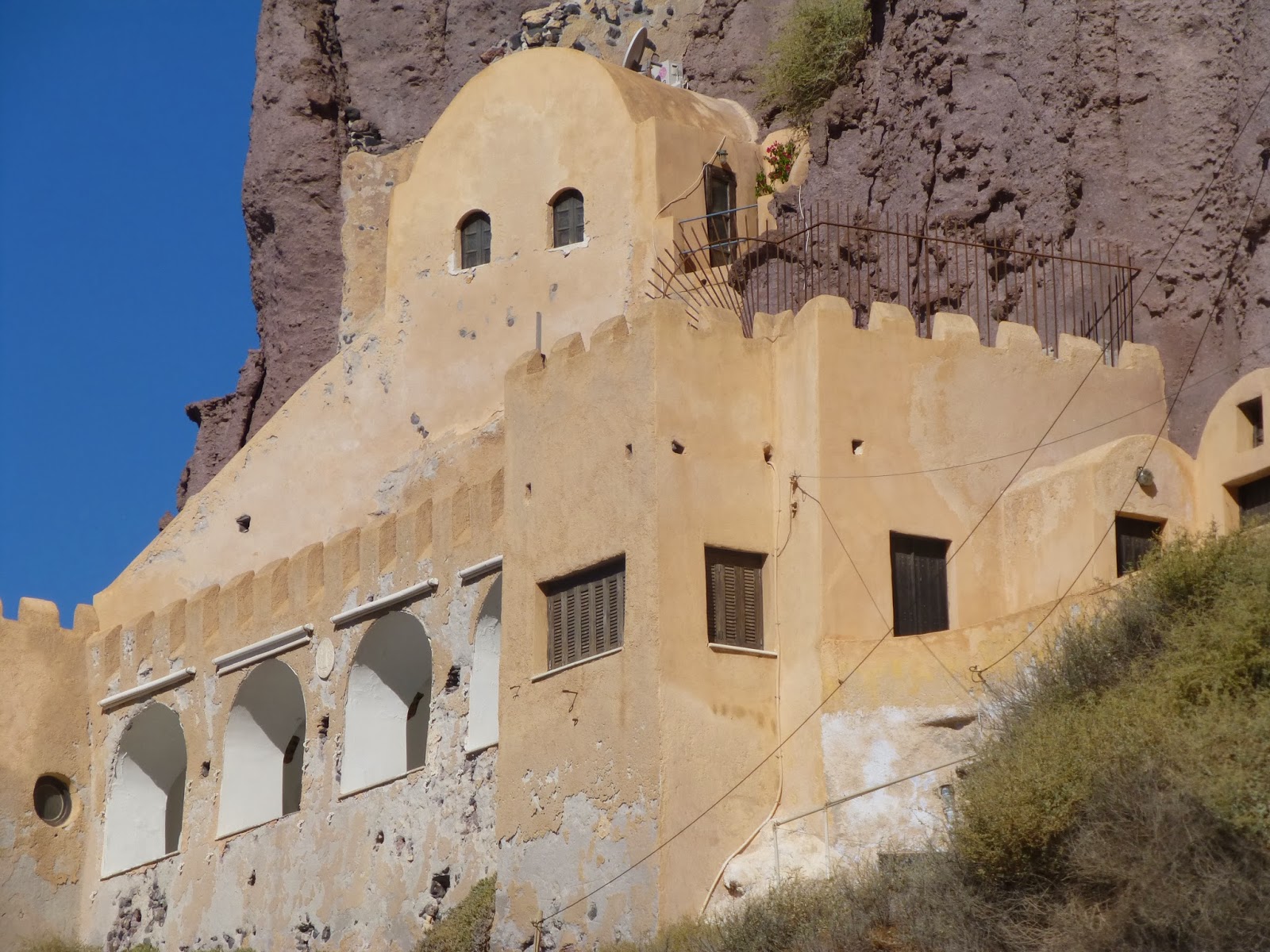
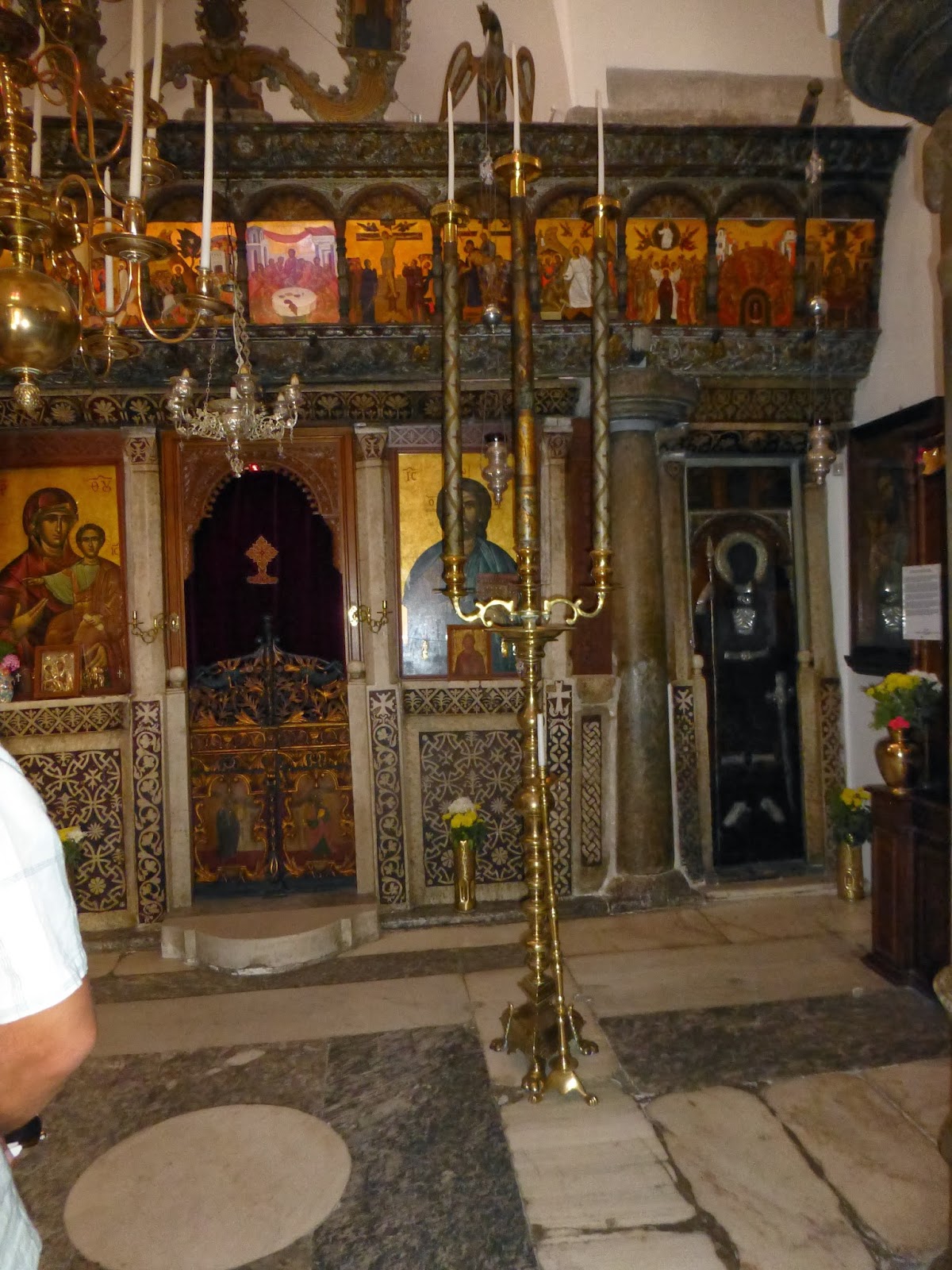
First up was a stop at a black sand beach, so called because the sand is solidified, dark, lava. Other lava beaches are white or red in color. Interestingly, the water at black sand beaches is the warmest because the black sand absorbs heat. We left the beach to wind along lonely roads etched into the hillside until we arrived at the 11th century Panagia Episkopi church, in the village of Episkopi Gonia. Marble columns still bear traces of color imparted long ago, when wax was melted over the porous marble and created scenes of then-vivid color. The church is noted for its ecclesiastical architecture, and also for its collection of paintings and architecture. Curiously, 26 of the finest icons were stolen in 1982 and none have ever surfaced on the world market.
View from the church's parking lot
Interior
Garden
And more of the surrounding garden
Black sand beach
On Santorini, vines are grown on the ground in a circle. When they no longer produce, they cut the tops off and let the roots start again. There is a vineyard here that purportedly has rootstock over 4,000 years old.
Typical village
We toured a few small villages and our guide explained that village houses are typically constructed one next to the other for two reasons. First, Santorini has a powerful, constant wind and building the homes in a contiguous fashion serves as a windbreak. Second, women were often left alone when their sailor husbands ventured offshore, and living near to one another established a safety net.
A tour of the Gaia winery was illuminating. Because of the strong winds, vines are grown in a circular format that eventually resembles a basket. This helps to protect the vines from the wind and also serves to hold the soil in place. Gaia has won several awards for its products, based primarily on the indigenous assyrtiko grape. One of the more interesting wines is
vinsanto, produced by sun-drying grapes to heighten the sugar content--the reverse of an ice wine--and the result is a sweet, delicious, dessert wine.
Tasting room. Not bad eh?
The vertiginous route to Oia is jaw-dropping and not for those afraid of heights. The reward for tolerating sheer drop-offs is an uninhibited view of the sea stretching to the horizon. Oia itself is unique, with sidewalks and alleys tumbling down the cliff to connect a series of structures, including some cave homes that have, over the decades, gone from squalid shelters to trendy, upscale homes. Famous for its view of the sunsets over the caldera, Oia is jammed with photo-hungry tourists as dusk descends. We enjoyed a pasta and lobster dinner at Ochre Wine Bistro, our view of the sunset sublime, and returned to Fira via the beach road as my wife's willingness to tolerate heights had long since been exhausted.
Classic Santorini view
Packed narrow streets
Not for someone terrified of heights!!!
One can easily picture being bumped over the edge!
Sunset from the restaurant's balcony
Full moon back on board our ship
A few interesting facts about Santorini: in most small hilltop villages, there are many areas inaccessible to motor vehicles. Accordingly, donkeys still serve to deliver goods, haul away trash, etc. This is common throughout the Greek isles. Also noteworthy is that, having been occupied by the Venetians for six generations, the Greek dialect on Santorini is replete with Italian words and phrases.
Of course, I'll remember little of this in a few years. But I won't soon forget the soft orange glow cast by the brilliant sun as it slowly disappeared into the glimmering sea.
We spent an overnight at sea, and anchored the next morning at the sheltered bay of Kolones beach, on the island of Kythnos, for a refreshing swim. We lunched on Kythnos and passed a fishing vessel that had landed a large, toothy shark. We were grateful not to have eyed the shark prior to our morning swim. Lunch was at a lazy, beachside restaurant where we enjoyed sun-dried, grilled octopus and watched time drift away with the lapping waves.
Shark, anyone??
Sun-dried octopus