Sunday, October 6, 2013

The Beautiful Crescent: Santorini

If there is a more beautiful island than Santorini in the Aegean, I haven't seen it.  As we cruised into the bay, nestled in a volcanic crater, or caldera, our view encompassed cliffs soaring over 1,000 feet and dotted with the stark white villages of Fira and Oia high above.  There are three ways to approach Fira: by funicular, by donkey along a steep, switch-back pathway, or by walking that same pathway.  As walking seems an option only for the masochistic, most of our group opted for the funicular or one of the rather forlorn-looking donkeys. 


To be candid, both Fira and Oia are the epitome of tourists towns, with street after street lined with restaurants and souvenir shops.  However, it doesn't matter: the views are undeniably spectacular.  Nothing constructed by man could detract from the view of endless shades of blue water, billowing white clouds, and the specks of islands that rise from the sea.  Let the cruise ships descend, let the tourist throngs pack the narrow streets, let the souvenir hawkers bark their loudest--the rapturous views from the peaks of Santorini will prevail.

We lunched at Selene restaurant, in the village of Pyrgos, and would recommend it to anyone for its creative cuisine and breathtaking vistas.  We engaged a guide to meet us at the restaurant and show us the island highlights.  Unfortunately, we had wanted to visit the renowned archeological site of Akrotiri, but it was closed due to a two-day strike by public workers.   There was, nevertheless, a variety of interesting sites to visit.

Seafood crocuettes

Octopus

Shellfish pasta


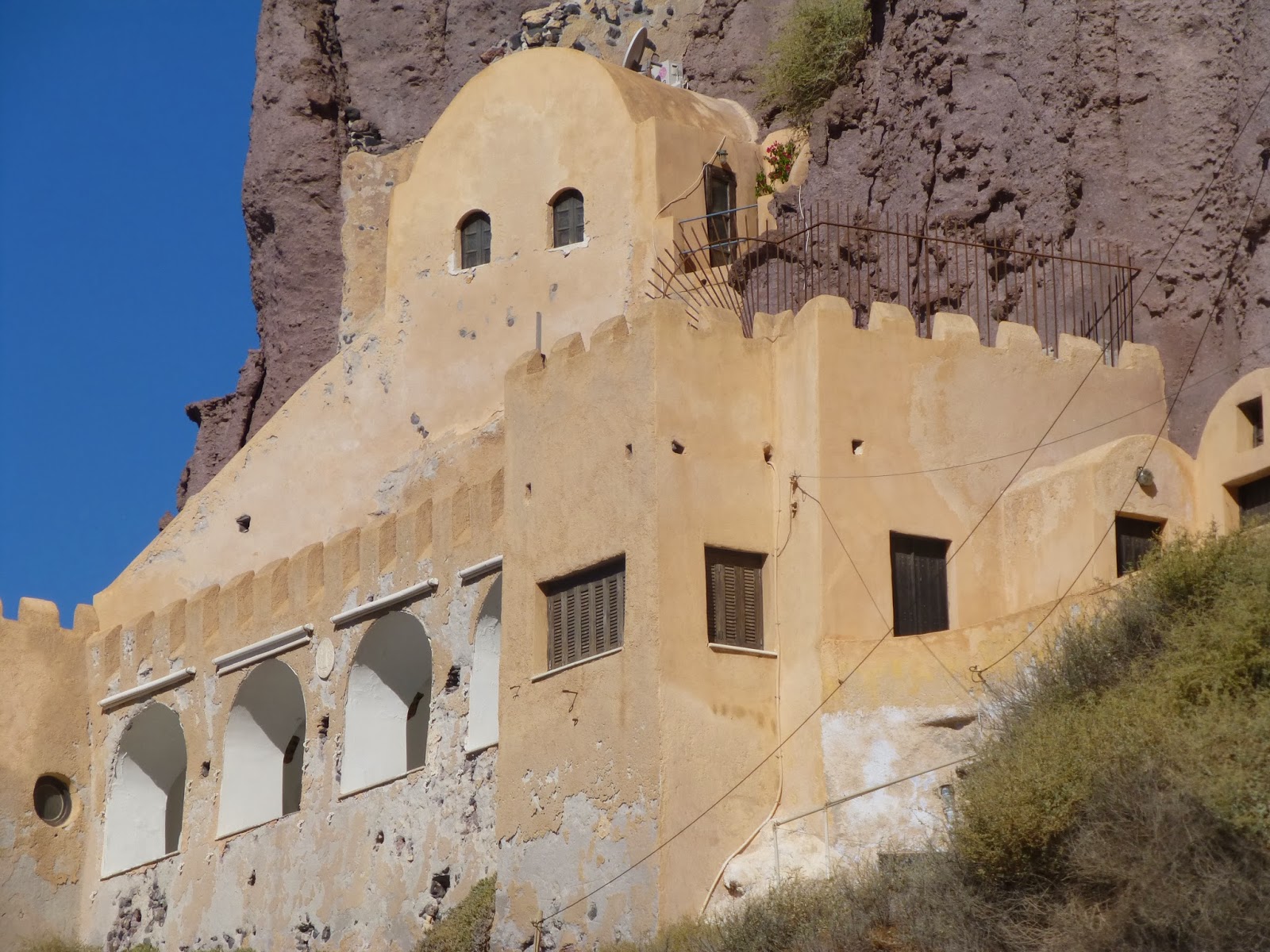
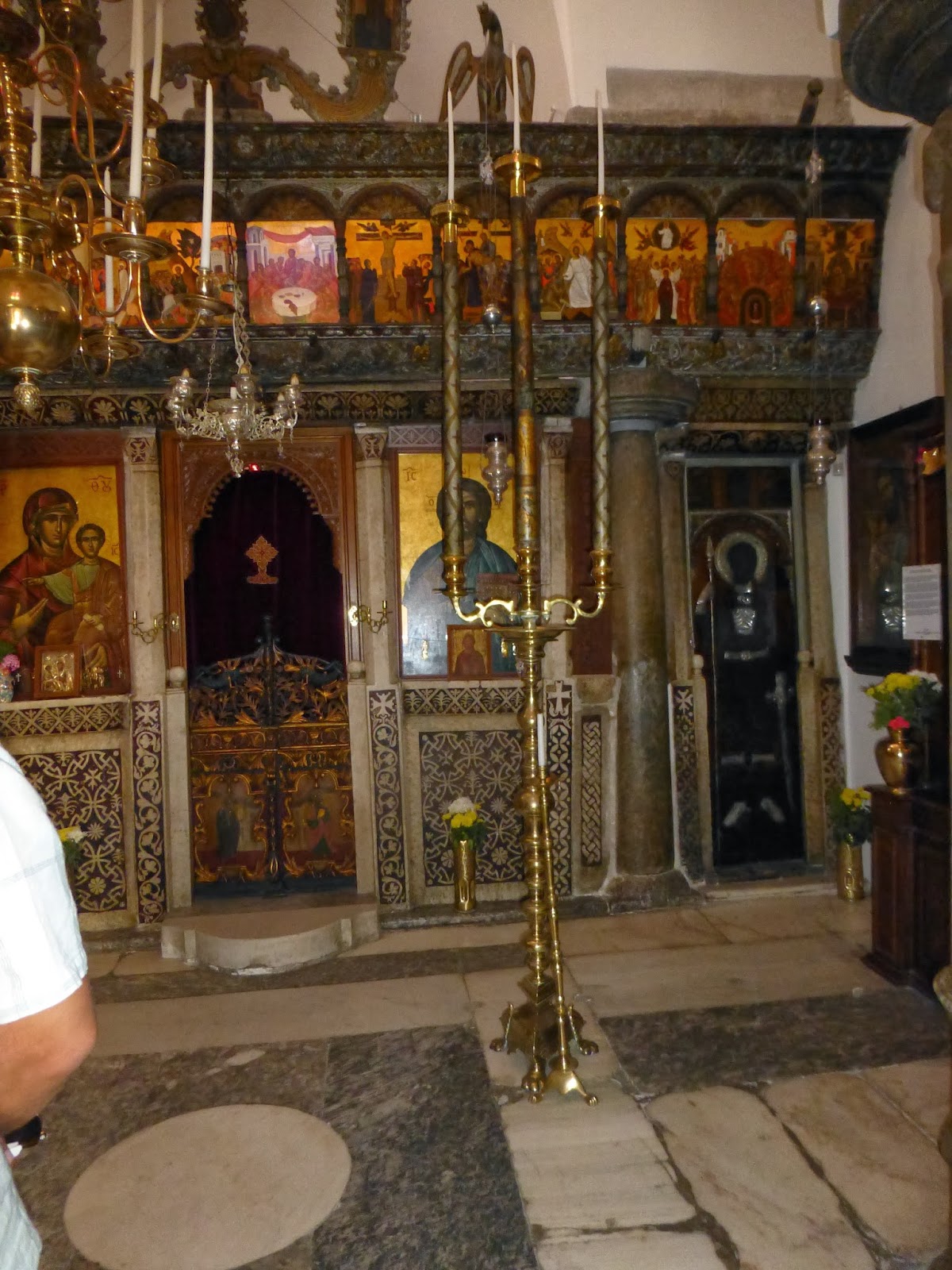
First up was a stop at a black sand beach, so called because the sand is solidified, dark, lava.  Other lava beaches are white or red in color.  Interestingly, the water at black sand beaches is the warmest because the black sand absorbs heat.  We left the beach to wind along lonely roads etched into the hillside until we arrived at the 11th century Panagia Episkopi church, in the village of Episkopi Gonia.  Marble columns still bear traces of color imparted long ago, when wax was melted over the porous marble and created scenes of then-vivid color.  The church is noted for its ecclesiastical architecture, and also for its collection of paintings and architecture.  Curiously, 26 of the finest icons were stolen in 1982 and none have ever surfaced on the world market.


                                                     View from the church's parking lot
 
Interior

 
Garden

 
And more of the surrounding garden


Black sand beach 

 
On Santorini, vines are grown on the ground in a circle.  When they no longer produce, they cut the tops off and let the roots start again.  There is a vineyard here that purportedly has rootstock over 4,000 years old.

 
Typical village


We toured a few small villages and our guide explained that village houses are typically constructed one next to the other for two reasons.  First, Santorini has a powerful, constant wind and building the homes in a contiguous fashion serves as a windbreak.  Second, women were often left alone when their sailor husbands ventured offshore, and living near to one another established a safety net. 

A tour of the Gaia winery was illuminating.  Because of the strong winds, vines are grown in a circular format that eventually resembles a basket.  This helps to protect the vines from the wind and also serves to hold the soil in place.  Gaia has won several awards for its products, based primarily on the indigenous assyrtiko grape.  One of the more interesting wines is vinsanto, produced by sun-drying grapes to heighten the sugar content--the reverse of an ice wine--and the result is a sweet, delicious, dessert wine. 


                                                         Tasting room.  Not bad eh?


The vertiginous route to Oia is jaw-dropping and not for those afraid of heights.  The reward for tolerating sheer drop-offs is an uninhibited view of the sea stretching to the horizon.  Oia itself is unique, with sidewalks and alleys tumbling down the cliff to connect a series of structures, including some cave homes that have, over the decades, gone from squalid shelters to trendy, upscale homes.  Famous for its view of the sunsets over the caldera, Oia is jammed with photo-hungry tourists as dusk descends.  We enjoyed a pasta and lobster dinner at Ochre Wine Bistro, our view of the sunset sublime, and returned to Fira via the beach road as my wife's willingness to tolerate heights had long since been exhausted.

 
Classic Santorini view

 
Packed narrow streets


                                                  Not for someone terrified of heights!!!


One can easily picture being bumped over the edge!


Sunset from the restaurant's balcony


Full moon back on board our ship
 
A few interesting facts about Santorini: in most small hilltop villages, there are many areas inaccessible to motor vehicles.  Accordingly, donkeys still serve to deliver goods, haul away trash, etc.  This is common throughout the Greek isles.  Also noteworthy is that, having been occupied by the Venetians for six generations, the Greek dialect on Santorini is replete with Italian words and phrases. 

Of course, I'll remember little of this in a few years.  But I won't soon forget the soft orange glow cast by the brilliant sun as it slowly disappeared into the glimmering sea. 

We spent an overnight at sea, and anchored the next morning at the sheltered bay of Kolones beach, on the island of Kythnos, for a refreshing swim.  We lunched on Kythnos and passed a fishing vessel that had landed a large, toothy shark.  We were grateful not to have eyed the shark prior to our morning swim.  Lunch was at a lazy, beachside restaurant where we enjoyed sun-dried, grilled octopus and watched time drift away with the lapping waves. 

                                                                    Shark, anyone??

                                                                  Sun-dried octopus


Saturday, October 5, 2013

Athens, City of Wonders

The bustling metropolis of Athens, home to over four million souls, boasts an array of incredible sites.  One, however, alone warrants a visit to Greece: the Acropolis.  Looming over 500 feet above the city, the Acropolis most impressive structure is the iconic Parthenon, which seems to captivate the eye day and night.  I have never witnessed any single structure so dominate its setting, like a vibrant king ensconced in a lush throne and gazing down upon his enthralled subjects.  One is humbled in the face of such tragic beauty, the fallen columns and weathered façade bearing majestic witness to a glory now faded with the passage of time. 


We stayed at the luxurious Grande Bretagne hotel, on Syntagma Square, and enjoyed our first few evenings off the boat.  During WWII, the hotel served as headquarters for the Greek military and, after the occupation, for the Nazis.  Today, with a rooftop pool, a fine restaurant with a view of the Acropolis, and a stellar bar, the Bretagne projects only tranquility. 

On our first day, we strolled through the Plaka, stretching uphill from the base of the Acropolis, toward the summit.  We entered the Acropolis through the Beule Gate and followed our guide up marble steps through the Propylaea, a structure designed to instill the appropriate reverence in those crossing into the spiritual world.  The Propylaea fulfills its function to this day, its mammoth columns dramatically framing the majestic Parthenon. 


                                                                         The Odeon


                                                                       Hephaistion


Dedicated to the Goddess Athena, the Parthenon is an expansive structure and one can only imagine how impressive it must have been when teeming with vibrant worshippers in all of its ornate, multi-colored, glory.  It is fascinating to appreciate that the architects--in the 400's B.C.--understood complex architectural methodologies, such as increasing the weight bearing capacity of the columns by slightly swelling them.  The Parthenon is an amazing, contemplative place. 


                                                                 Theater of Dionysus

Temple of Zeus


Hadrian's Gate

From the heights of the Acropolis, we also enjoyed viewing the Odeon, the Theater of Dionysus, and the Hephaistion, the best-preserved of the ancient Greek temples.

The Erechtheion is another structure not to miss, principally due to the delicate sculptures of maidens, the caryatids, who support the portico.  The folds of their robes are designed to resemble the flutes of columns, and their chiseled faces remain hauntingly beautiful to this day.  The original sculptures are now housed in the New Acropolis Museum, a modern, airy edifice that displays many pieces of pottery and sculpture excavated from the Acropolis.


There is also a display area that awaits the return of the Elgin marbles from the British Museum.  The display, a series of squared surfaces many of which face the Acropolis through a glass wall, contains some stones of the frieze that once graced the Parthenon.  Other sections of the frieze, taken by Lord Elgin and now housed at the British Museum, are duplicated in plaster.  Greece has long demanded the return of the Elgin marbles and, to date, Britain has refused.  Elgin's supporters argue that he saved the frieze sections from the Turks who then ruled Greece and had no interest in the Parthenon.  His detractors argue that he was no more than a thief.   One argument advanced by Britain in support of its refusal to return the marbles was that Greece lacked a facility to properly preserve and display them.  Greece's answer:  The New Acropolis Museum.

We enjoyed dinner that evening at Café Avyssinias, in the Monesteraki district adjacent to the Plaka.  The view was captivating as our eyes are inexorably drawn to one compelling site: the Parthenon, awash in the radiant glow of soft, golden lights and silhouetted against the dark night sky.  We laughed and chatted over cups of wine and platters of food but, inevitably, there would be a welcome lapse in our conversation as we gazed upon the ancient temple and enjoyed a moment of silent reflection. 


Friday, October 4, 2013

A Farewell to Greece


On our final day in this bustling city, we caught the changing of the guard at the Parliament building and enjoyed a stroll through the National Garden to the Temple of Zeus.  The huge temple now has only fifteen columns that remain in place, but they convey a sense of how incredibly impressive the Temple must have been.


We spent the afternoon strolling and shopping, enjoying an espresso and absorbing the ambiance of the city.  While we did not visit the National Archeological Museum on this occasion, I highly recommend the museum for its expansive collection of Greek antiquities, including the impossibly moving bronze statute, the Jockey of Artemision.


Our final evening was spent enjoying a cocktail (okay, three) with friends, then proceeding to dinner in the Grande Bretagne's excellent restaurant and its view, of course, of the Acropolis.  Our table enjoyed seafood and lamb and each dish was expertly prepared.  The lamb took top honors.


We packed reluctantly, not anxious to bring such an incredible trip to an end.  However, travelling with friends, old and new, affords us the opportunity to meet and revel once more in our adventures.  To recall evenings of sea bream and sardines, of laughter and wine and ouzo and raki.  Oh, and vodka, always vodka.   May we sail together again, my friends, and never forget the days when we made the lovely country of Greece our own.